Depeche Mode’s Signature Sound Was Built in the Workflow
Depeche Mode’s most enduring records were shaped as much by production decisions as by songwriting: drum programming, synth layering, sample manipulation, and a mix philosophy that made machines feel emotional. Here’s a teardown of the producers, tools, and techniques behind the band’s sound.
The Depeche Mode Sound Was Never Just the Band
Depeche Mode’s catalog is often discussed as if the sonic identity arrived fully formed with the songs themselves. In reality, the band’s signature voice was manufactured in the control room as much as in the writing room. The producers behind Depeche Mode didn’t simply capture performances; they built arrangements from drum machines, sequencers, samplers, and layered synth parts, then shaped the mix so every sound had a job.
That’s why the band’s records feel so engineered, so tactile, and so emotionally specific. Their best producers understood that Depeche Mode’s music works when the production is both disciplined and dramatic: sparse enough to let the hook breathe, dense enough to feel industrial, and polished enough to hit on radio without losing its edge.
The Early Blueprint: Daniel Miller and the Minimal Synth Logic
Before the grand, cinematic era, Daniel Miller helped define the band’s early language at Mute by favoring a stripped, electronic-first workflow. The early Depeche Mode records leaned on simple sequencing, dry drum-machine patterns, and hook-driven arrangements that left a lot of negative space. The point wasn’t sonic maximalism. It was clarity.
On records like Speak & Spell, the production emphasized machine precision: bright synth lines, repetitive bass figures, and compact song structures. The arrangement logic here is important. Instead of stacking many competing parts, the producers allowed one synth hook, one rhythmic pattern, and one vocal idea to dominate at a time. That approach made the songs instantly memorable and created a template the band would later complicate.
From a production standpoint, the lesson is simple: if you want the listener to remember the hook, stop fighting it. Reduce the number of simultaneous elements. Let the groove and melody do more of the work.
Gareth Jones and the Art of Mechanical Atmosphere
By the mid-80s, Depeche Mode’s sound had become darker, deeper, and far more textural. Gareth Jones was central to that evolution. His work with the band helped translate stark electronic parts into immersive, physical records. Jones had a reputation for treating the studio as an instrument, and that approach is all over Depeche Mode’s middle-period catalog.
What changed under this production style? First, the drums became less like polite electronic backing and more like structural events in the arrangement. Snare hits were allowed to carry weight. Toms and percussion were used to create momentum. Second, the synth palette became more layered and harmonically ambiguous. Pads weren’t just background color; they created tension against the vocal and bass parts.
The other key move was space. Jones’s productions often use reverb and delay not as decoration but as arrangement tools. A vocal delay tail can bridge sections. A long reverb on a snare can make a chorus feel larger without adding another instrument. That’s a critical Depeche Mode technique: atmosphere is often used to change scale.
Alan Wilder: Arrangement as Sound Design
If one figure most clearly connected Depeche Mode’s sound to production craft, it is Alan Wilder. As a musician, programmer, and arranger, Wilder operated like an internal producer who understood how to turn fragments into a coherent sonic architecture. His presence transformed the band’s workflow into something far more detailed and cinematic.
Wilder’s contribution was not just playing parts; it was deciding which sonic events deserved focus. He was known for meticulous layering, sample editing, and structural experimentation. In practical terms, that meant building songs from loops, one-shots, live takes, and processed textures that were often chopped, repitched, or recontextualized inside the arrangement. You hear that mentality on albums where the groove feels alive but never sloppy.
One of the most important Wilder-era ideas is that the arrangement itself can act like a mix. If a part is introduced early but filtered, muted, or heavily treated, then later opened up with full bandwidth and less effect, the listener perceives movement even if the harmony barely changes. That is classic Depeche Mode tension: the song evolves through timbre and density rather than constant chord motion.
Flood: Making the Machine Feel Human
By the time Depeche Mode reached the period most associated with their stadium-scale identity, Flood became a defining producer. His strength was not just making things bigger, but making electronic music feel physical and emotionally unstable in the right way. He brought a more aggressive, performance-driven sensibility to the band’s studio process.
Flood’s Depeche Mode productions often hinge on contrast. A programmed groove may be rigid, but the vocal phrasing sits slightly ahead of or behind the beat. A synth bass may lock in like a machine, while top-line textures smear across the stereo field. That push-pull is a large part of the band’s emotional charge. The record sounds sequenced, but it never feels emotionally static.
In mix terms, Flood’s era often emphasizes impact over polish. Drums hit harder, guitar textures become more prominent, and the low end is managed so the arrangement can breathe at arena scale. The takeaway for producers is that “big” does not mean “busy.” It means every frequency range has a clear role, and dynamics are used strategically to create lift.
Synthesis Choices: Oscillators, Filters, and the Power of Repetition
Depeche Mode’s sound is often described as synth-heavy, but that undersells the precision of the choices. The band’s producers consistently used synthesis in service of arrangement. Instead of endlessly showcasing sounds, they repeated memorable timbres until those timbres became part of the song’s identity.
Common production traits include:
- Filtered synth bass with a focused midrange presence that cuts through dense mixes.
- Detuned pads and string-like textures used to widen the emotional field without stealing rhythm.
- Short, percussive sequences that behave almost like guitar riffs.
- Analog and sampled drum hits layered for punch and character.
The important thing is that these sounds are rarely left untouched. Filtering, distortion, modulation, and tape-like saturation are part of the composition process. A synth patch is not merely selected; it is often pushed until it occupies exactly the right emotional register.
Sampling and Editing: The Hidden Engine of the Band’s Texture
As samplers became central to electronic production, Depeche Mode’s studio workflow got more detailed. Samples were not only used as obvious effects. They were woven into the rhythm section, doubled with synths, and edited into hybrid sounds that blurred the line between drum machine, acoustic percussion, and found noise.
This is one of the reasons the band’s records retain interest on repeated listens. The ear keeps discovering micro-events: reversed tails, clipped transients, ghosted percussion, abrupt filter moves, and background layers that seem to appear only for a bar or two. Those details are not accidental. They are part of the arrangement language.
For modern producers, this is a useful reminder: sample choice matters, but sample editing matters more. A basic sound can become iconic if it is trimmed tightly, layered intelligently, and placed in the arrangement with intention.
Mix Philosophy: Width, Contrast, and Controlled Grit
Depeche Mode’s best mixes are never pristine in a sterile sense. They are controlled, but they preserve enough grit to feel alive. The low end is often disciplined and relatively centered, while the upper-mid and high-frequency textures are spread wider through delay, chorus, reverb, and duplication. That contrast helps the vocal stay anchored while the instrumental field expands around it.
Another hallmark is the use of dynamic arrangement to create mix movement. Instruments enter and exit in ways that change perceived loudness without requiring heavy automation everywhere. A track may feel larger in the chorus not because every fader jumped by 3 dB, but because the arrangement opened up: extra harmonics arrived, the reverb tail widened, or the bass stopped masking the kick.
That is a much more musical way to think about mixing. Instead of asking, “How do I make this louder?” Depeche Mode’s production legacy asks, “How do I make this section feel bigger without losing clarity?”
What Modern Producers Can Steal From Depeche Mode
The band’s production legacy is still highly usable today, especially for producers working in synthwave, dark pop, industrial, alt-electronica, and modern club-adjacent pop. The core lessons are not tied to specific vintage gear.
- Start with arrangement. Build around one dominant groove or motif before adding color.
- Use synthesis as structure. A patch should support the song’s role, not just sound impressive in solo.
- Employ contrast. Pair rigid sequencing with human vocal phrasing or organic noise.
- Edit samples aggressively. Shorter, more intentional layers often hit harder than polished clutter.
- Let space do work. Reverb, delay, and dropout moments can define section changes better than extra instrumentation.
If there is one unifying idea behind the producers of Depeche Mode, it is that the emotional power of the band came from disciplined construction. The records are not just arrangements of songs. They are systems of texture, rhythm, and tension, built so carefully that the production becomes inseparable from the songwriting.
That’s the real Depeche Mode lesson: signature sound is not a preset. It is a workflow.
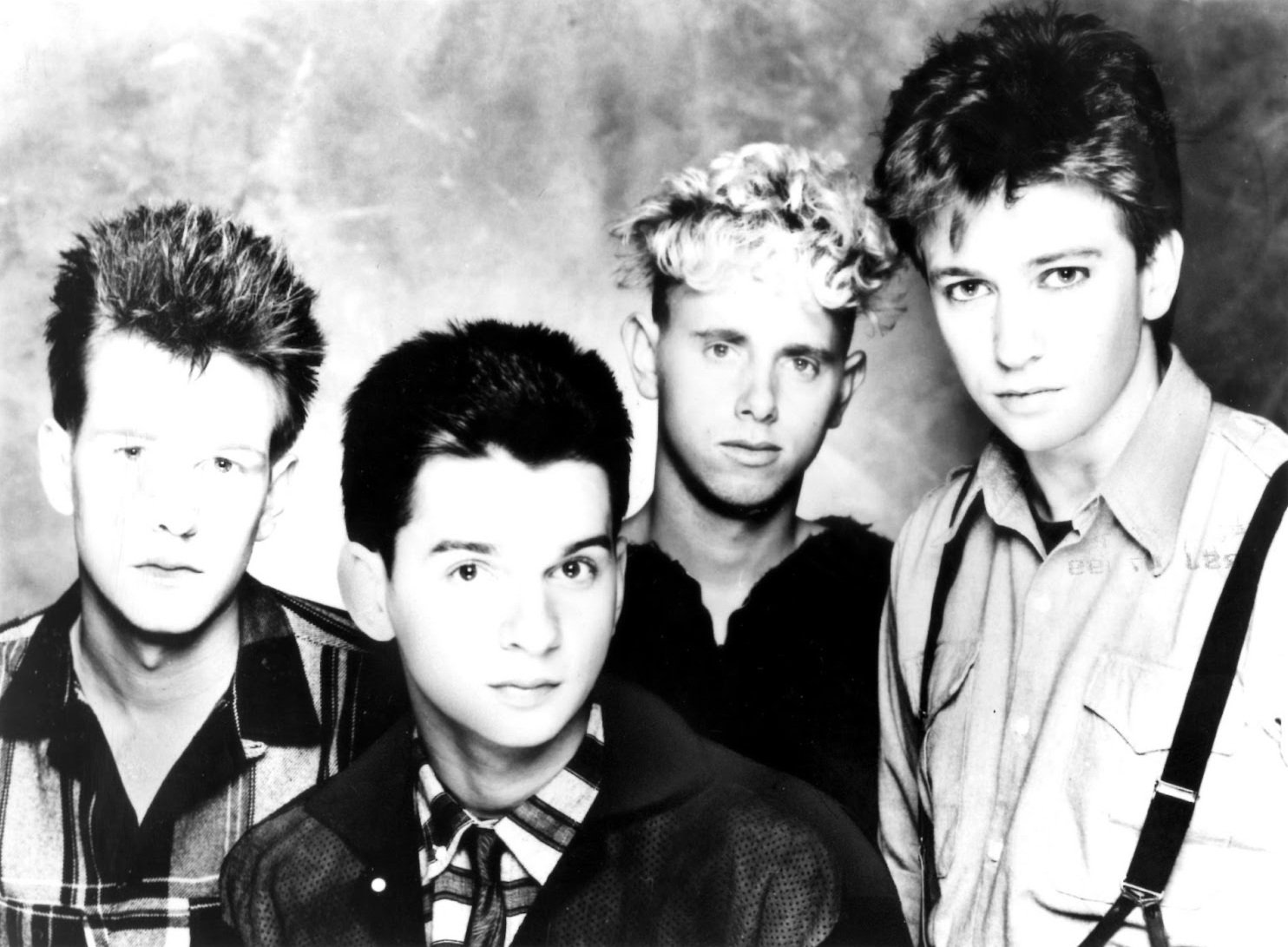
Image: Depeche Mode 1983.jpg | U.S. Press Kit for Construction Time Again at Worthpoint• eBay, Archive, No copyright markings on front or back of photo. Higher resolution version here | License: Public domain | Source: Wikimedia | https://commons.wikimedia.org/wiki/File:Depeche_Mode_1983.jpg