The Sound Design of Producer Communities: Where Modern Music Makers Actually Learn
The best online communities for producers are less about endless scrolling and more about fast feedback, credible ears, and repeatable growth. Here’s how to spot the forums, Discords, and groups that sharpen your mixes, expand your toolkit, and keep your ears honest.

The real job of a producer community
For producers, the best online communities are not just social spaces. They are functionally part of the studio: a place to troubleshoot routing, compare plugins, stress-test mix decisions, and hear how other ears react before a track ever reaches a distributor. The difference between a useful community and a noisy one is simple: one improves your judgment, the other just feeds your feed.
That distinction matters because production is full of blind spots. You can spend three hours EQing a kick drum and still miss that the low end collapses on small speakers. You can overcook a synth patch and not realize the magic disappeared under the compression. You can also sit inside a bubble of people who all make the same genre, with the same samples, the same references, and the same bad habits. The right online community breaks that loop.
Think of these spaces as listening rooms. The cues to pay attention to are not just opinions, but the quality of the feedback: does someone identify a frequency problem, mention arrangement density, or suggest a reference track? Those are the signs you are in a room with working producers, not just commenters.
What separates a good producer forum from a dead one
Not every community deserves your attention. The strongest producer forums and Discord servers tend to share a few traits. First, they reward specificity. A post that says “my mix sounds muddy” should get better responses if the community is healthy. Even better is a reply like “your bass and low tom are masking around 120 to 180 Hz, and your pad is holding too much energy in the lower mids.” That kind of language is worth far more than generic praise.
Second, good communities have a visible listening culture. Members post references, A/B comparisons, stem previews, and mix revisions. That creates a feedback loop where you can track improvement rather than just collecting opinions. Third, moderation matters. The best spaces filter out self-promotion, gear-bragging, and unproductive ego fights. If every thread becomes a plugin argument or a spam dump, the community is failing at its core job.
Finally, the best communities are genre-aware without becoming genre-locked. A house producer, a film composer, and a trap beatmaker may approach arrangement differently, but they all benefit from discussions about gain staging, stereo imaging, saturation, and ear fatigue. A strong community understands both the craft and the context.
Forums, Discords, and social groups each serve a different ear
There is no single “best” online community for all producers because each format works differently. Forums are still the strongest place for searchable knowledge. If you want a detailed breakdown of how a certain compressor behaves on a drum bus, or whether an interface has real latency issues, a forum thread often outperforms a fast-moving chat room. The archive is the advantage. Years later, the discussion is still there.
Discord communities are better for speed. Need feedback on a snare choice before you commit? Want a second opinion on whether your low end is translating? A good Discord can feel like a live control room, especially for producers working in deadlines or collaborating across time zones. The tradeoff is depth. Valuable advice can disappear under active conversation, so the strongest Discords usually pair fast chat with pinned resources, searchable channels, and clear topic separation.
Social groups on platforms like Facebook or Reddit can be useful for breadth and discovery, but quality varies wildly. The upside is scale: you can compare workflow habits across thousands of producers, find niche communities for modular synthesis or orchestral mockups, and catch early chatter about new plugins or sample packs. The downside is noise. You will need a sharper filter to separate informed opinions from easy takes.
Listening cues that tell you a community is worth joining
When evaluating a producer community, listen for the way people describe sound. Good feedback usually includes one or more of these cues:
- Frequency language: comments about sub energy, harshness, boxiness, or masking
- Dynamic language: talk of transient control, punch, glue, headroom, and pumping
- Arrangement language: notes on buildup, drop contrast, density, and section flow
- Reference-based critique: comparisons to specific records, not vague genre labels
- Technical clarity: advice that mentions routing, gain staging, sidechain behavior, or stereo management
If you see those cues often, you are probably in a serious room. If the dominant language is “fire,” “mid,” or “send it,” without any explanation, the community may still be fun, but it is unlikely to accelerate your growth.
Another strong sign is revision culture. Healthy communities do not just react to a first draft; they encourage second passes. Producers post Version 1, receive comments, then return with Version 2, and the discussion gets more precise. That process mirrors real production work. Great tracks are rarely born finished.
Where producers actually get better
The most useful online communities are the ones that create repeated exposure to better decisions. That can happen in a few specific ways. In feedback threads, you start hearing common mix problems faster. In sound design channels, you learn how other producers build patches from scratch instead of relying on presets. In gear discussions, you get a reality check on whether a new interface, controller, or saturation plugin is actually solving a problem or just flattering your curiosity.
For example, a producer who spends time in a serious synth community will eventually stop asking, “What preset sounds like this?” and start asking, “Is this movement coming from filter modulation, wavetable position, or post-FX automation?” That shift is massive. It turns passive sound consumption into active sound construction.
Likewise, a mixing community that values comparison can help you hear translation more clearly. Someone may point out that your track sounds huge on monitors but loses definition on phone speakers because the midrange harmony is too sparse. Another producer may suggest checking the mono sum of the chorus to expose phase issues in your widened synth stack. Those are the kinds of notes that save releases.
Best practices for getting value fast
Joining a producer community is easy. Using it well is the harder skill. Start by posting with context. Include the genre, reference track, what you want feedback on, and the exact issue you are hearing. “Please roast this” is not a brief. “I’m trying to get the kick and bass to hit like early Disclosure, but the sub disappears after the drop” is a useful starting point.
When you ask for feedback, upload the right version. If you are mixing, post a clean bounce without mastering. If you are sound designing, include a dry version and the processed version. If you are troubleshooting, describe your signal chain. The clearer the input, the more precise the output.
Also, contribute before you extract. Communities get stronger when members answer other people’s questions, share preset tips, post stem breakdowns, and explain what actually fixed a problem. If you only show up when you need help, you are missing the point.
The communities worth your time are the ones that sharpen your ears
Producer forums, Discords, and online groups can absolutely improve your work, but only if they are built around listening, specificity, and craft. The best communities do not just tell you what is good; they teach you how to hear why it is good. That is the real advantage.
If a community helps you diagnose a muddy low end, build a stronger drum bus, choose better references, or understand why a synth patch feels alive instead of flat, it is doing its job. If it leaves you more distracted, more opinionated, and no closer to finishing records, move on.
For serious producers, the right online community is not background noise. It is part of the signal chain.
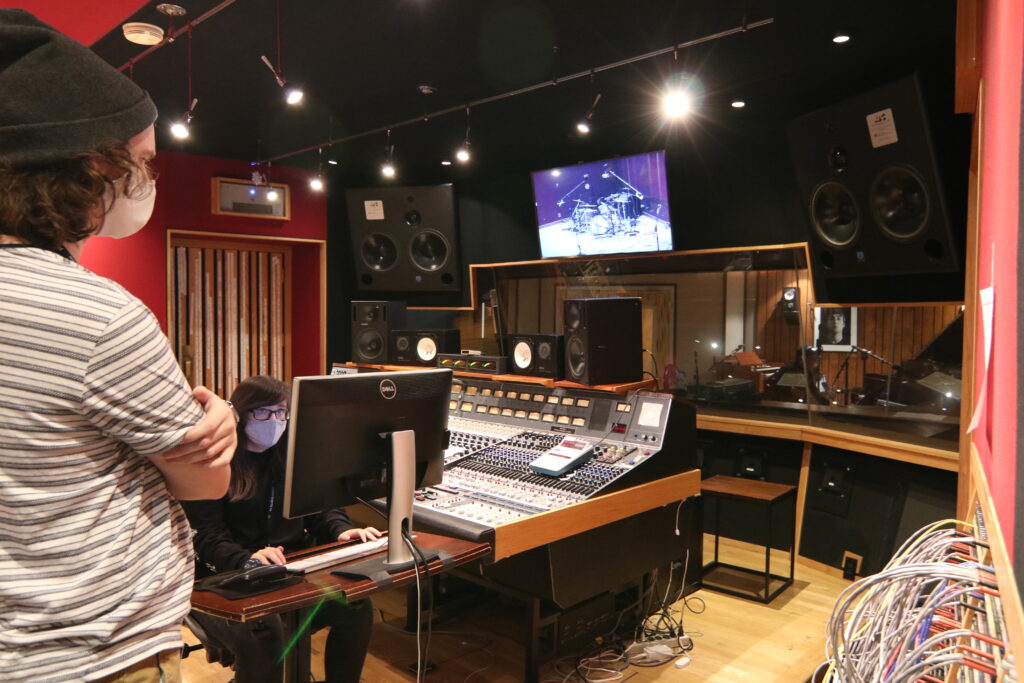
Image: A music producer works in a sound studio with microphones and speakers, creating audio content. | cottonbro studio | License: Pexels License | Source: Pexels | https://www.pexels.com/photo/back-view-of-a-woman-sitting-in-the-music-studio-5657673/