Best Drum Machines for Rock and Electronic Fusion: The Ones That Actually Fit in a Real Session
If you’re blending live-band punch with programmed precision, the right drum machine can do far more than sketch demos. This guide breaks down the machines that hold up in rock-electronic fusion sessions, from gritty pattern work to hands-on performance control.
Why rock-electronic fusion needs a different kind of drum machine
Rock and electronic fusion is not just “drums plus synths.” The drums have to carry impact, attitude, and movement without flattening the band feel. That means the best drum machine for this job is rarely the most famous one on paper; it is the one that can deliver punchy transients, believable accents, and enough performance control to sit beside guitars, bass, and vocals without sounding pasted on.
In a hybrid track, the drum machine usually plays one of three roles: it becomes the backbone, it augments a live kit with extra layers, or it acts as a writing tool that generates patterns later transferred to audio. The machine you choose should match that role. A cold, perfectly quantized pattern can work if the arrangement is already loose and human. A more organic or analog-feeling box may be the better call if you want the groove to breathe under distorted guitars.
What matters most when choosing a hybrid-friendly drum machine
1. Sound character. Rock fusion needs drums that hit hard in the low mids and midrange. Kick drums should have weight without turning to mush under bass guitar. Snares need body, crack, and enough transient to survive layers of cymbals, synth stabs, and guitar distortion.
2. Sequencing feel. If you want patterns that evolve like a band performance, look for probability, parameter locks, song mode, and real-time recording. The more the machine can do beyond a static 16-step loop, the more useful it becomes in a hybrid context.
3. Individual outputs and processing. Separate outs or strong USB audio integration matter because hybrid production almost always ends in layered processing. You will likely compress the kick differently from the snare, distort the toms, and send percussion to parallel ambience.
4. Hands-on control. If the machine feels good to program, you will use it more. That matters because rock-electronic fusion thrives on iteration: changing accents, muting parts mid-song, swapping fills, and moving between rigid and humanized timing quickly.
5. Ability to coexist with live drums. Some machines are excellent for pure electronic music but awkward when stacked with acoustic drums. The best hybrid boxes provide tonal flexibility, fast edits, and enough punch to stay clear inside dense arrangements.
The standout drum machines for rock and electronic fusion
Elektron Digitakt II: the modern hybrid workhorse
If you are building rock-electronic fusion tracks in 2026, the Digitakt II is one of the most practical choices. It is not a classic “drum machine” in the vintage sense, but it excels at the exact jobs hybrid producers need: sample chopping, step sequencing, pattern variation, and creative resampling.
Its strength is how easily it turns a simple kick-snare loop into a living arrangement. You can layer your own live drum hits, sequence glitchy percussion, and use parameter locks to change tuning, filter settings, or sample start points from step to step. That makes it ideal for tracks where a straight four-on-the-floor beat needs to mutate into a half-time rock breakdown or a noisy chorus lift.
Best for: producers who want deep sequencing and sample manipulation rather than a fixed “drum machine sound.”
Roland TR-8S: the most immediate bridge between eras
The TR-8S remains one of the most convincing answers if you want classic machine energy with modern routing and flexibility. Its value in rock fusion is obvious: it gives you that hard-edged, performance-ready Roland groove, but also lets you load samples, shape kits, and run the machine like a live instrument.
For hybrid productions, the TR-8S works especially well when you want electronic drums to feel assertive instead of overly detailed. It is a strong fit for punk-electronic, industrial rock, synthrock, and anything that wants a drum machine part to feel like part of the band arrangement instead of a hidden production trick. The performance faders and muting workflow make it easy to build tension during bridges or strip drums back to a skeletal pulse before a chorus slam.
Best for: players and producers who want instant, tactile sequencing with recognizable machine punch.
Elektron Analog Rytm MKII: for serious sound design and drum abuse
The Analog Rytm MKII is one of the most powerful choices if your hybrid style leans heavy, aggressive, or cinematic. This is a machine built for drum programming that can survive saturation, compression, and layered processing without losing shape.
Its analog voices are dense and muscular, and the sampling layer means you are not locked into a narrow palette. For rock-electronic fusion, that matters because you can build kits that feel part electronic, part industrial, part live percussion. Add overdrive, compression, and performance macros, and the Rytm becomes a serious front-end for genres that need drums to sound big enough to compete with amplified instruments.
It is not the cheapest option, and it does reward commitment. But if your tracks depend on drums being as expressive as guitars, this is one of the best investments available.
Best for: producers who want thick analog impact plus performance-oriented control.
Roland TR-8S + external samples: the practical studio hybrid
If you are not looking for a flagship “all-in-one” solution, a TR-8S loaded with your own sampled kicks, snares, claps, and percussive textures can be the smartest studio path. Rock-electronic fusion often benefits from custom sample packs built from live drum recordings, Foley, drum room mics, and processed one-shots.
This approach gives you a machine that feels like a curated instrument rather than a preset box. You can trigger a snare sampled from a real kit, layer it with a synthetic clap, and send the result through bus compression and tape-style saturation. The tonal result is often more convincing than relying on factory sounds alone.
Best for: studios that want flexibility and a familiar workflow with personalized kits.
Arturia DrumBrute Impact: budget-friendly, raw, and performance-ready
The DrumBrute Impact is a strong lower-cost option for artists who want a tactile machine that encourages writing by feel. It is punchy, raw, and immediate. In a hybrid rock context, that rawness can be an advantage because it leaves room for later processing and does not over-polish the groove.
Its step sequencing is simple but musical, and the performance-oriented controls make it easy to push patterns into more human territory. It is especially useful for bands or producers who want to sketch drum ideas fast, rehearse arrangements, or run a dedicated electronic percussion part live without diving into deep menu structures.
Best for: writers who want an affordable, hands-on machine with enough grit to survive in a rock mix.
MFB Tanzbär Lite and similar analog boutique boxes: for character over convenience
Boutique analog drum machines can be excellent in this genre if you want personality over feature overload. Many of these units deliver immediate tone and a slightly unruly feel that works well with guitars and live bass. They are often less polished than mainstream flagships, but that can be the point. Rock-electronic fusion benefits from a little instability when the rest of the arrangement is rigid.
The tradeoff is workflow. Smaller manufacturers often make you work harder with simpler sequencing, fewer outputs, or limited memory. If your process is arrangement-driven and you want lots of evolving patterns, you may outgrow them. If you want an instrument that sounds alive the second you press play, they can be inspiring.
Best for: producers chasing grit, immediacy, and a less standardized drum voice.
When a drum machine is better than samples in this genre
A sample pack can absolutely deliver the sound of fusion, but a drum machine gives you something samples often do not: interactive timing and live arrangement control. If you need to switch from verse restraint to chorus aggression in real time, mute percussion fills, shorten decay, or push a snare into a breakdown, hardware sequencing is faster and more performative.
Drum machines are especially useful when the beat itself is part of the arrangement identity. Think of a song where the electronic pulse is almost a second rhythm section, locking against the drummer rather than replacing them. In those cases, the machine is not just a source of sounds; it is a compositional tool.
When plugins may be the smarter choice
For many producers, a plugin can do the job with less cost and less setup. If you are already working entirely in the box, tools like Battery, XO, Geist, or sampled emulations of classic drum machines can get you 80 percent of the way there. Plugins win on recall, easy automation, and endless kit swapping.
That said, if your hybrid music depends on spontaneous pattern changes, hardware mutes, and physical performance, hardware still has an edge. The best choice is not always “hardware versus software.” In many sessions, a drum machine writes the idea and a plugin or DAW session finishes the mix.
Best use-case recommendations

Choose the Elektron Digitakt II if you want sample-based control, advanced sequencing, and experimental hybrid programming.
Choose the Roland TR-8S if you want classic machine impact, performance controls, and fast live-friendly operation.
Choose the Analog Rytm MKII if you want thick analog drums, serious processing power, and a premium performance workflow.
Choose the DrumBrute Impact if you want a cheap, inspiring, hands-on box for writing and rehearsing.
Choose boutique analog machines if you value character and are willing to trade away some convenience.
The bottom line

The best drum machines for rock and electronic fusion are the ones that help you make arrangement decisions quickly. That usually means punch, flexibility, and sequencing features that support variation instead of dead repetition. A hybrid track lives or dies on contrast: tight versus loose, mechanical versus human, synthetic versus acoustic. The right machine makes those contrasts easier to shape.
If you are buying for a real studio workflow, prioritize a machine that can evolve with your process. The most useful drum machine is not the one with the longest spec sheet; it is the one you will actually program when the guitars are loud, the bass is moving, and the song needs a beat that can keep up.
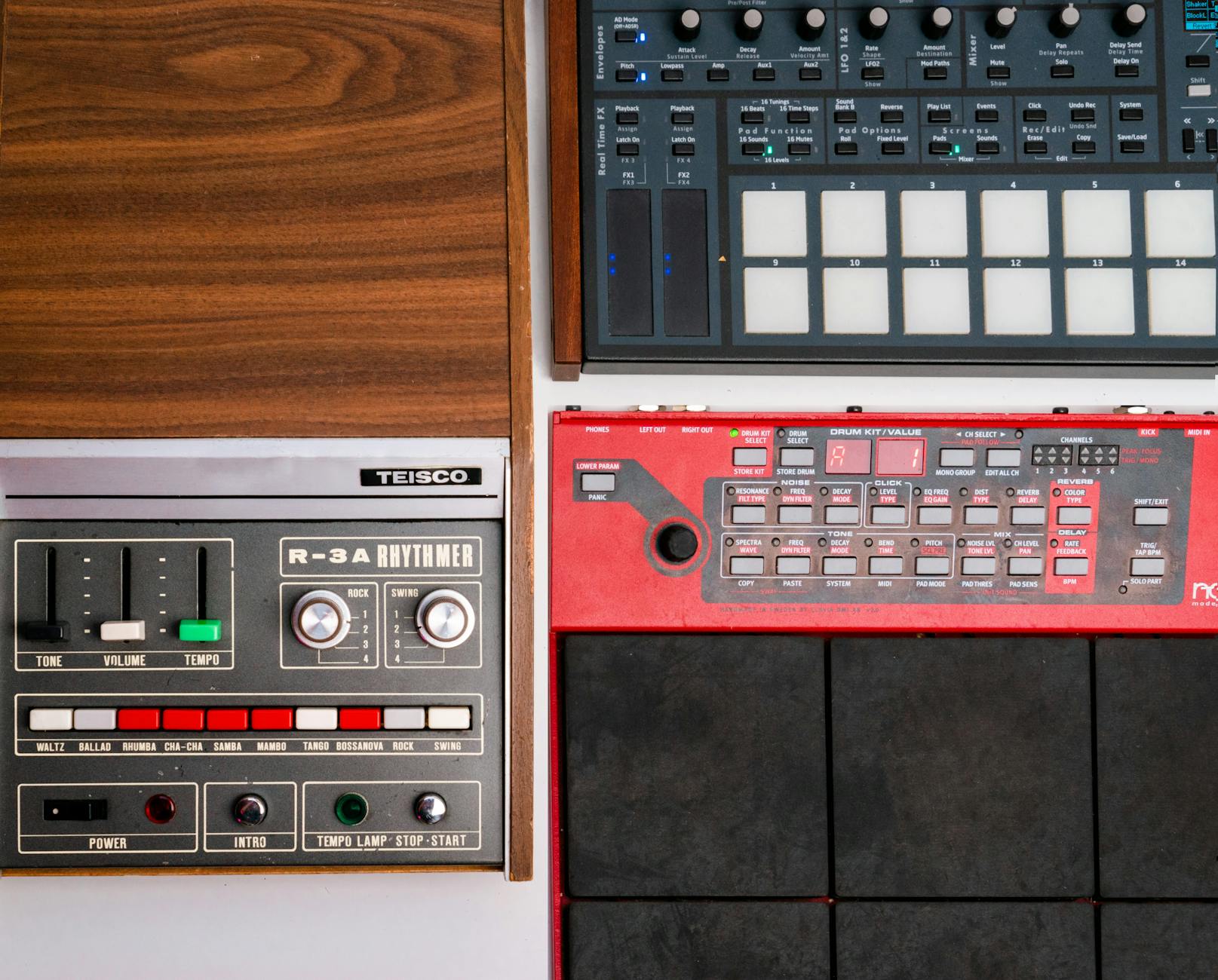
Image: A collection of vintage audio and drum machines viewed from above, showcasing retro technology. | Alena Sharkova | License: Pexels License | Source: Pexels | https://www.pexels.com/photo/close-up-photo-of-audio-mixer-9875199/