Inside Deftones’ Textural Violence: The Guitar Layers, Arrangement Tricks, and Mix Choices Behind the Blur
Deftones don’t just write heavy songs—they build pressure systems. This breakdown looks at the guitar layering, atmospheric synthesis, and mix decisions that let their riffs hit hard without losing depth.
Deftones have spent decades proving that heaviness doesn’t have to arrive in a straight line. Their records feel dense, emotional, and enormous, but that impact rarely comes from brute-force riffing alone. The band’s signature sound lives in the space between pressure and release: distorted guitars that don’t simply punch, but bloom; arrangements that leave air for ambience to hang inside the low end; mixes that let texture count as much as attack.
What makes Deftones technically distinctive is not just tone, but layering discipline. The band consistently treats the guitar rig as a multidimensional instrument system—one that can supply rhythm weight, harmonic haze, melodic shimmer, and percussive bite all at once. Their records are a masterclass in using effects and arrangement as composition tools, not decoration.
The core formula: riffs with negative space
At the heart of a Deftones track is often a riff that could function as standard metal material on paper: low tunings, syncopation, palm-muted movement, and a strong emphasis on the low-mid impact zone. But the arrangement around that riff is what changes everything. Instead of stacking constant wall-of-guitar density, Deftones often build songs around selective saturation—letting one guitar carry the chug while another swells, rings, or delays into the gaps.
This is important because it alters the listener’s perception of aggression. When every bar is full, the ear adapts and the impact flattens. When the arrangement creates a tension curve—tight riff, open chord bloom, clipped stop, feedback tail—the heavy sections hit harder because they’re contrasted by atmosphere. Deftones understand that silence, or near-silence, can be as heavy as a down-tuned guitar stack.
Guitar tone as a layered system, not a single preset
Deftones’ guitar tone is often described as “huge,” but that word hides the real method. The band’s signature sound depends on multiple tones serving different functions. A main rhythm guitar may occupy the center with a focused midrange bite, while a second part is processed with modulation, delay, or reverb to expand width and depth. In many cases, the atmospheric part is not meant to compete with the riff—it’s meant to contour it.
In practical production terms, that means the guitar tone is rarely finalized at the amp alone. The sound is shaped by:
- Pickup choice and tuning: helping the guitar sit in an extended low register without turning muddy.
- Amp voicing: enough midrange aggression to stay readable after layering.
- Effects order: delay and modulation often behave differently depending on where they sit relative to gain.
- Double tracking strategy: not every part is duplicated identically; some layers are meant to smear, not lock.
That last point is especially central. A conventional metal mix often rewards surgical tightness across all guitars. Deftones frequently aim for something more organic and elastic. Slight variation between takes or tonal layers makes the guitars feel like they are breathing rather than machine-stitched. The result is a sound that stays powerful but never sterile.
Effects as composition: chorus, delay, reverb, and the art of blur
Deftones’ atmosphere is not just “more reverb.” Their best productions use effects to shape emotional distance. Chorus can widen a clean or semi-clean figure without making it disappear. Delay can turn a sparse melodic fragment into a rhythmic ghost. Reverb can push a guitar behind the vocal or place it inside a larger emotional room.
What matters is restraint. The band’s atmospheric layers are usually placed so they expand the song without swallowing it. A delay tail might sit just under the next chord change, creating momentum. A chorus-drenched part may occupy the upper mids while the rhythm guitar stays dry and physical below. Reverb often works best when filtered or darkened, which keeps the ambience from fighting the snare and cymbals.
For producers trying to recreate the effect, the takeaway is simple: do not use ambience as an all-or-nothing blanket. Use it surgically. High-pass your reverbs. Roll off low-end on delayed returns. Automate effect depth so the arrangement can move between intimacy and expanse.
Arrangement decisions do the real heavy lifting
Deftones’ tracks are often more sophisticated in arrangement than they first appear. A song may begin with a spacious clean guitar or a suspended chord voicing, then gradually introduce distortion, then strip back to a half-time pulse, then return with a chorus that feels huge because the earlier sections were comparatively restrained. This ebb-and-flow structure is crucial to the band’s identity.
Their writing often relies on register management. Guitars are not constantly occupying the same sonic lane. One layer may live in the low-mid body of the riff, while another sits higher with shimmer or feedback. Vocals are allowed to float above rather than fight through a wall of distortion. Bass is frequently given enough room to reinforce the weight without turning the entire mix into one undifferentiated block.
This is why Deftones can sound massive without sounding overcompressed in the compositional sense. The songs are arranged to let different textures dominate at different moments. In one section, the riff is the star. In another, a sustained guitar harmonic or keyboard pad may become the emotional center. That constant shifting keeps the music cinematic.
Synthesis and ambient layers: the invisible glue
While Deftones are fundamentally a guitar band, synthesis and ambient production elements play an important role in their modern sound. Pads, drones, subtle keyboard textures, and sampled ambience can reinforce the harmonic mood without announcing themselves overtly. These layers often sit low in the mix, but they do a lot of work: they smooth transitions, fill gaps between dynamic sections, and increase the perceived scale of the record.
From a production standpoint, these synth layers often behave like a parallel environment rather than a lead element. They may follow the chord progression with long attack and release times, or they may sustain a single tone that reinforces the emotional center of the key. The key is that they support the guitar arrangement instead of competing with it. When done right, they make the guitars feel bigger because the guitars are no longer responsible for building all the atmosphere on their own.
The mix: clarity inside density
The biggest challenge in a Deftones-inspired mix is preserving detail while keeping the emotional blur intact. That means the mix cannot simply be “wide and heavy.” It has to be organized. Typically, the low end must be controlled enough that kick and bass remain defined, while the guitars retain enough midrange presence to read on small speakers. If the guitars are scooped too aggressively, the atmosphere may feel impressive in isolation but collapse in context.
Mix engineers chasing this sound should think in terms of contrast:
- Dry vs. wet: keep the core riff more direct and push supporting layers into ambience.
- Midrange attack vs. high-frequency haze: let one part provide articulation while another provides sheen.
- Mono anchor vs. stereo bloom: center the foundation, widen the texture.
- Transient focus vs. sustain: preserve the pick attack so the guitars don’t become a fog machine.
Compression should support that architecture rather than flatten it. Heavy bus compression can be useful if it’s allowing sustained ambience to feel glued together, but too much gain reduction can erase the micro-dynamics that make the band’s arrangements feel alive. The same caution applies to saturation: just enough to thicken, not so much that the layers merge into one static texture.
What producers can steal from the Deftones playbook
If you want the Deftones effect in your own productions, don’t start by copying a pedalboard. Start by building an arrangement that can hold tension. Write riffs with room for a second emotional layer. Record one guitar part that is dry, strong, and rhythmically precise, then design another that adds blur, sustain, or harmonic movement. Use synths or ambient textures to fill in what the guitars are not saying.
Most importantly, think in scenes rather than presets. Deftones records work because the band and production team understand that atmosphere is not a genre garnish—it is part of the song’s structure. The heaviness lands because the surrounding air is carefully shaped. The blur is intentional. The distortion is only one layer of the architecture.
That is the real lesson of Deftones: metal can be massive without being monolithic. When guitars, synthesis, and mix design are treated as interlocking parts of the composition, the result is a sound that feels less like a wall and more like weather.
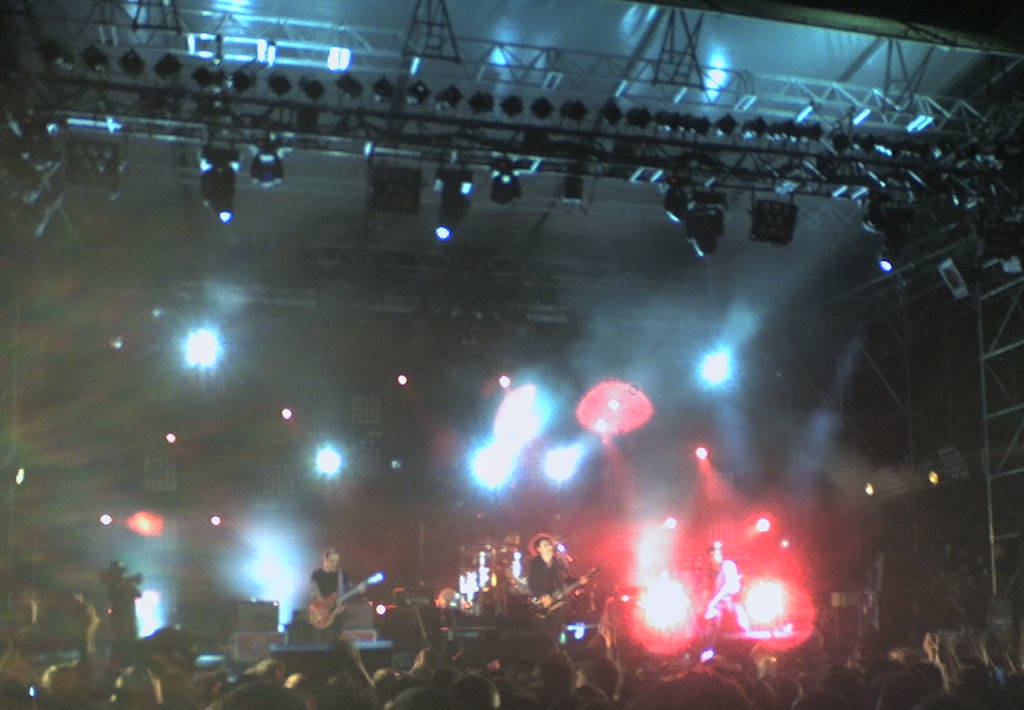
Image: Deftones Orbit Room 20070614.jpg | Own work | License: Public domain | Source: Wikimedia | https://commons.wikimedia.org/wiki/File:Deftones_Orbit_Room_20070614.jpg