Inside Hans Zimmer’s Cinematic Soundscape Machine
Hans Zimmer’s scores don’t just accompany a film—they move like architecture. Here’s how layered synths, hybrid orchestration, and ruthless textural design create that signature widescreen tension.
The Zimmer Sound Is Built, Not Written
Hans Zimmer’s signature isn’t just melody, harmony, or even orchestration. It’s scale. His music feels like a physical environment because it’s constructed from stacked layers of rhythm, texture, harmony, and movement, each doing a specific job in the emotional architecture. The trick is that Zimmer rarely treats any single sound as the final word. A string line might carry the motif, but the body of the cue often comes from synth doubles, processed percussion, low-end drones, and evolving tonal beds that fill the negative space beneath the orchestra.
That layered approach is the reason his scores can feel both massive and intimate. He uses synthesis not as decoration, but as structural reinforcement. In practical terms, that means a cue often begins with a simple musical idea and then gets built into a multi-tiered soundscape: one layer for pulse, one for harmonic weight, one for atmospheric motion, one for sub pressure, and one for the human or orchestral front edge. The result is not “big” in a generic blockbuster sense—it’s dimensional.
Layering as Arrangement, Not Just Sound Design
One of the most important lessons in Zimmer’s work is that layering is an arrangement decision before it is a mixing decision. Instead of asking, “What synth should I use?” the better question is, “What role does this layer play in the cue?” Zimmer-style stacking works because each element occupies a different emotional and spectral function. A high synth shimmer can suggest air and distance. A midrange analog pad can imply tension or warmth. A distorted low oscillator can turn a gentle harmonic bed into something ominous. Percussive synth hits can create momentum without needing constant drum programming.
This is why his scores often feel deceptively simple when reduced to the top line. Beneath the obvious themes, there may be multiple ostinatos interlocking at different rhythmic resolutions. One layer might pulse in eighth notes, another in dotted quarters, while a third evolves slowly enough that the listener feels change without consciously hearing it happen. That constant motion is essential: Zimmer’s soundscapes are almost never static. Even when the harmony is held, the texture is moving.
For producers, the takeaway is clear. Don’t stack sounds that all do the same thing. Build a cue the way a film editor builds tension: one layer advances the scene, another widens it, another destabilizes it.
The Hybrid Orchestra Is the Core
Zimmer is famous for blurring the line between acoustic and electronic forces. Strings are often reinforced with synths; brass can be doubled or shadowed by low electronic weight; choir textures may sit on top of processed pads to extend their emotional reach. This hybrid method is what gives the music its impact in modern theatrical playback systems and trailers alike. Pure orchestral arrangements can feel elegant, but Zimmer’s hybrid language feels cinematic in a more contemporary, muscular way.
A useful way to think about it is that the orchestra provides identity while synthesis provides scale. Orchestral instruments offer familiar cues of drama, humanity, and narrative tradition. Synths add control over sustain, tone, and frequency extension. For example, string ostinatos may be recorded with a realistic attack, but then reinforced with a subtle synth pluck or pulse so the pattern hits harder in the low mids and cuts more cleanly through dense percussion. Likewise, a brass stab can gain extra menace when layered with a filtered saw wave or a sine-based sub hit that tracks the fundamental.
This hybrid philosophy is also why Zimmer’s productions often feel so “finished” even in a sketch stage. The emotional intent is embedded in the arrangement choices themselves. The production is the composition.
Low End as Emotional Gravity
If there is one element that separates Zimmer’s soundscapes from conventional cinematic writing, it’s the low end. The subs, drones, bass pulses, and timpani-like impacts are not there simply to sound impressive—they anchor the emotional weight of the cue. Zimmer and his collaborators often build tension by keeping the low end alive even when the upper arrangement feels sparse. That sub motion can be a sustained note, a slowly filtered oscillator, or a repeated pulse that changes slightly each bar to prevent fatigue.
In a practical session, this might mean layering a clean sine sub under a distorted bass patch, then carving out enough room so the two translate as one composite gesture. The sine provides fundamental clarity, while the distorted layer contributes harmonics that remain audible on smaller speakers. Add a touch of pitch modulation, and the low end starts to feel alive instead of just loud.
Zimmer’s low-frequency writing also relies on contrast. A huge brass-and-bass moment only works if the preceding bars have left room for the drop to land. That means dynamic restraint matters as much as impact. The modern blockbuster sound is often accused of being constantly maximal, but Zimmer’s best cues know when to hold back so the next swell hits with real force.
Rhythm Through Texture
Zimmer’s rhythmic language is often less about traditional drum-kit groove and more about textural propulsion. Pulses, ticks, risers, reversed tails, and layered percussion create forward motion without locking the cue into a strictly pop or rock framework. This is part of why his music translates so well to trailers and action sequences: it can accelerate a scene without sounding like a beat-driven track.
In production terms, this means rhythm is distributed across the spectrum. High-frequency clicks can imply urgency. Midrange toms and taikos provide physicality. Low sweeps and subs create momentum at the bottom. Even pads can contribute rhythm if they’re gated, sidechained, or modulated in time with the picture. A Zimmer-style cue may not have a traditional “beat,” but it still has pulse, breath, and impact.
For producers trying to recreate this, a good exercise is to mute the drums and see if the track still feels like it moves. If the answer is yes, the rhythm is being carried by the arrangement itself rather than a single percussion part. That’s the level at which Zimmer often operates.
The Role of Sound Design Tools and Plugins
Zimmer’s aesthetic depends on tools that let sounds mutate rather than simply play back. Granular processing, convolution reverb, distortion, transient shaping, filtering, pitch manipulation, and layered ambience all play a part in shaping his cinematic palette. While the exact tools vary by project and collaborator, the philosophy remains consistent: sounds should feel sculpted for the scene.
Plugins that excel at moving textures, heavy ambience, and hybrid sound design are especially useful in this lane. Multi-layered reverbs can push a synth into a massive acoustic space. Tape-style saturation can thicken otherwise sterile digital oscillators. Filter automation can turn a static pad into a living organism. Delay feedback, when used carefully, can create the sense of distance or dread that a straightforward note simply cannot achieve.
The important point is not to collect cinematic plugins for their own sake. The sound becomes convincing when processing decisions support narrative function. A reversing effect should feel like a breath being pulled into a transition. A granular smear should imply memory or collapse. A distorted low drone should feel like pressure under the scene.
Zimmer’s Biggest Production Lesson: Emotion Comes From Control
It’s tempting to hear Hans Zimmer’s work and assume the recipe is simply “more layers, more reverb, more low end.” In reality, the opposite is true. The power of his soundscapes comes from control—control over frequency range, register, density, and timing. Every layer has a reason to exist, and every cue is shaped around the exact emotional contour of the scene.
That means his signature sound is not just about making things large. It’s about making them inevitable. The music feels like it was designed to move in a certain direction, and that sense of direction is what audiences experience as cinematic power.
For producers, the most useful Zimmer takeaway is this: stop thinking of a track as one instrument playing a part. Think like a sound architect. Build surfaces, depths, and motion. Use synthesis to support narrative, not just tone. Let the arrangement do the emotional heavy lifting, then use processing to fuse the layers into one coherent force.
How to Apply the Zimmer Approach in Your Own Sessions
If you want to work in this style, start with a narrow concept and expand only where the cue demands it. Write a simple motif or harmonic figure, then ask what sonic layers would make it feel larger, darker, or more urgent. Double important lines with synths that reinforce the fundamentals. Add at least one evolving texture that changes over time. Use low-end elements sparingly but deliberately. Above all, automate movement so the cue never feels frozen.
A practical Zimmer-inspired template might include: a string or piano motif, a pad with slow filter modulation, a sub layer doubling the root, a rhythmic pulse in the midrange, a high ambient texture, and a percussion bed that supports the scene rather than dominating it. From there, shape the space with reverb and delay, then refine the spectrum so each element remains legible.
That’s the real lesson hidden inside Hans Zimmer’s cinematic soundscapes. They are not just big. They are engineered to feel emotionally inevitable, and that is what makes them endure.
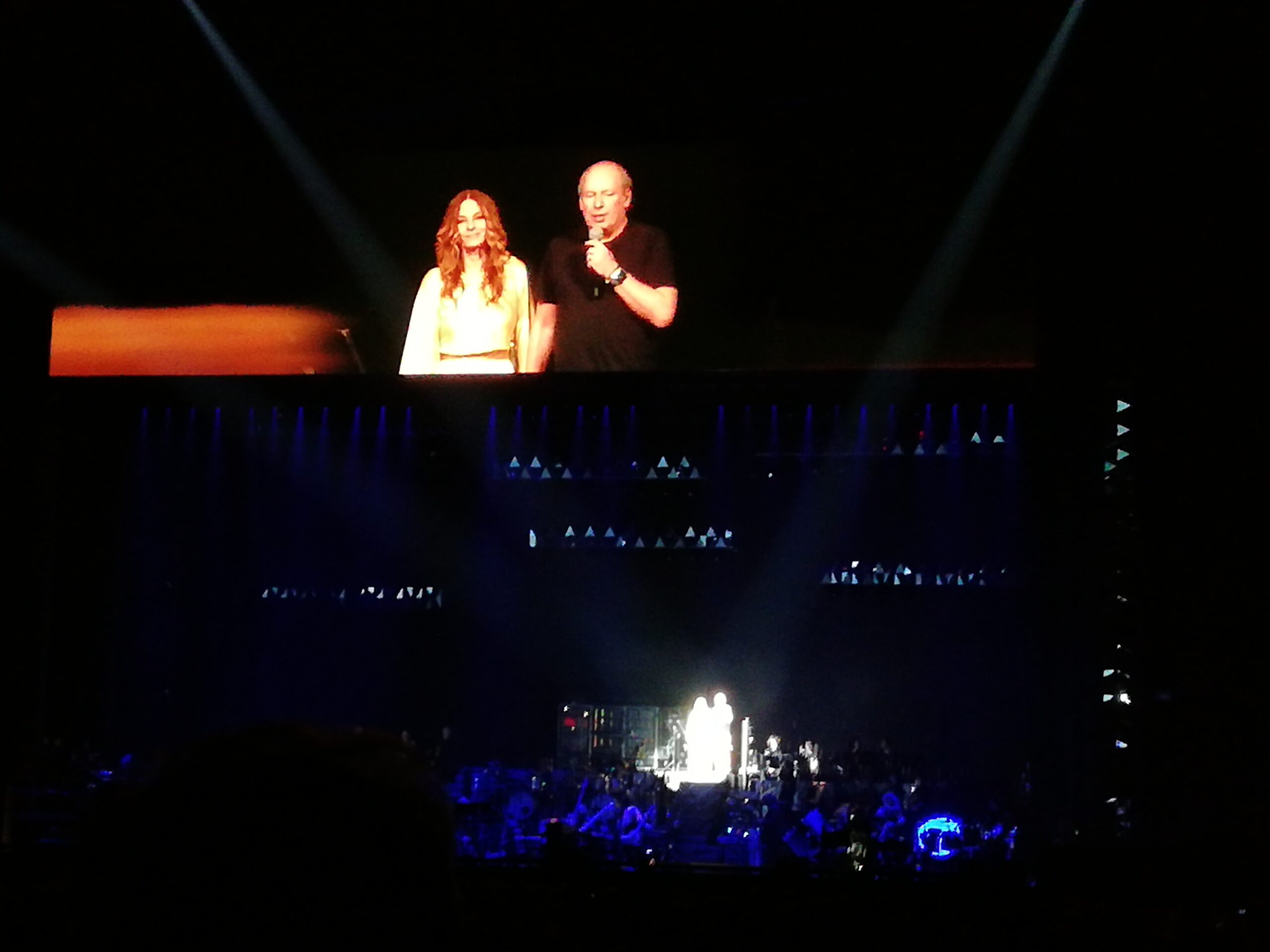
Image: Hans Zimmer live 2022 with female singer.jpg | Own work | License: CC BY-SA 4.0 | Source: Wikimedia | https://commons.wikimedia.org/wiki/File:Hans_Zimmer_live_2022_with_female_singer.jpg