Inside Martin Garrix’s Festival Formula: Arrangement, Synthesis, and the Mix Decisions That Make the Drop Hit
Martin Garrix’s biggest records are not just big melodies and loud drops—they’re tightly engineered arrangements built for maximum impact on massive systems. Here’s a breakdown of the workflow, sound design habits, and mix choices that turn his ideas into festival-ready anthems.
The Garrix Formula Starts Before the Drop
Martin Garrix’s records are often discussed in terms of sheer scale, but the real trick is that the scale is baked into the writing process. His music doesn’t simply get loud at the drop; it is arranged to feel like it has been accelerating toward that moment the entire time. That distinction matters. A festival hit isn’t just a good lead sound over a heavy drum loop. It is a carefully staged sequence of tension, release, and contrast that leaves no doubt when the drop arrives.
Garrix’s production style sits in that sweet spot where pop instinct meets club engineering. He thinks in hooks, but he builds them with the discipline of an electronic producer who understands frequency balance, dynamic range, and translation on a massive PA. The result is music that can feel immediate to a casual listener and still reward producers who are listening for the details.
Arrangement as a Pressure System
One of the defining features of Garrix’s workflow is his sense of arrangement as pressure management. He tends to avoid cluttering the song too early. Instead, he introduces ideas in layers, making each section feel like it is carrying the listener one step closer to the payoff. That means the intro often establishes pulse and tonal identity without revealing the full emotional weight of the track.
Festival records live and die on contrast. Garrix knows this instinctively. If the build is too busy, the drop loses impact. If the verse is too empty, the listener disengages. His arrangements typically balance these competing needs by using very deliberate changes in density: kick and sub, then top-line fragments, then risers, then a stripped pre-drop, and finally the full-impact drop. The choreography is classic EDM, but the spacing is what makes it work.
For producers, the practical takeaway is simple: think in energy curves, not just sections. Ask what information each part of the song gives the listener, and what information you are withholding. A Garrix-style arrangement is rarely about constant novelty. It is about timing the reveal so the drop feels inevitable.
Melody First, But Engineered for Mass Singalong
Garrix has always been a melody-forward producer. Even when the sound design is aggressive, the strongest records usually have a topline or lead phrase that is easy to remember after one pass. That does not mean the melodies are simplistic. It means they are optimized for quick recognition, especially in a live environment where the audience may only hear them once before the drop lands.
This is where his festival instincts show up. Big-room and mainstage records need motifs that can survive distance, crowd noise, and huge reverberant spaces. Garrix tends to favor melodic shapes that are rhythmically clear and harmonically direct. The phrasing is often compact, with a few notes doing a lot of emotional work. In a festival context, that economy is an advantage. The crowd can latch on immediately, and the tune cuts through even when the mix is dense.
If you are trying to emulate that approach, focus on motif development rather than endless melodic variation. A short, strong phrase repeated with subtle changes in harmony, octave placement, or call-and-response layering will often hit harder than a more elaborate line that lacks memorability.
Sound Design: Wide, Bright, and Controlled
The Garrix drop sound is usually massive, but the mass is organized. His synth design often relies on a combination of layered leads, midrange grit, and stereo width, with each element occupying a specific role. The core idea is almost always clear: create something that feels huge without collapsing into a blurry wall of sound.
That usually means a few common production moves. First, the lead stack is often built from multiple layers rather than a single patch. One layer might provide the fundamental tone and punch in the mids. Another might add brightness and attack. A third could contribute texture, saturation, or a formant-like edge. The goal is not just thickness—it is controlled contrast inside the stack.
Second, the sound often uses width in a disciplined way. Festival leads are frequently wide enough to feel cinematic, but the center remains stable. That center anchor is crucial because it keeps the record from sounding phasey or weak on mono systems. Producers chasing this sound should treat width as a tool, not a default. Hard-panned duplicates, microshift-style widening, and stereo harmonics can all be effective, but the low end and the main transient information need to stay locked.
Third, Garrix-style leads usually have a polished brightness that helps them cut. That sheen can come from wavetable sources, saw stacks, saturation, or careful high-end enhancement, but the important part is that the top end is expressive rather than harsh. On a festival system, harshness gets fatiguing fast. The best dance records have bite, but they do not punish the listener.
Drums Built to Support the Hook, Not Fight It
Another underrated part of the workflow is how the drums support the melodic identity. In Garrix productions, drums are often strong but rarely overcomplicated. The kick is designed to establish authority without dominating the whole spectrum, the clap or snare provides a clean event marker, and the hats and percussion help the track move without turning the groove into a distraction.
That restraint is part of why the drops feel so effective. When the lead is the star, the drum programming needs to give it room. You will often hear a mix of punchy transients and relatively straightforward patterns that keep the energy high while leaving space for the melodic hook to do the heavy lifting. The drums are not there to audition for attention; they are there to frame the moment.
For producers, this is a useful reminder: if your drop sounds crowded, the problem may not be the lead. It may be the supporting percussion. Remove one or two elements and listen again. Often the perceived size of the drop increases when the arrangement becomes cleaner.
Mix Decisions That Make the Drop Feel Bigger
Garrix’s mixes are generally built around clarity, impact, and translation. That combination is deceptively hard to achieve, especially in a genre where loudness temptation is constant. What makes his records work is not just that they are mastered hot; it is that the mix is arranged so each sonic role remains intelligible under pressure.
Low-end control is one of the biggest priorities. The kick and bass relationship has to remain stable, especially in music designed for enormous systems. A festival mix cannot afford a muddy sub region or a kick that gets swallowed by the bass layer. That usually means carefully managing the envelope of each low-frequency element, using sidechain compression or volume shaping to create space, and making sure the sub is centered and phase-consistent.
Midrange management is equally important. Garrix leads are often rich in the upper mids, where the ear perceives presence and forward motion. But too much energy in this range can make a mix aggressive in a bad way. The art is in carving enough room that the melody feels urgent without becoming abrasive. Dynamic EQ, multiband control, and selective saturation can all help tame spikes without flattening the sound.
The drop also benefits from strategic pre-drop contrast. A short silence, a filtered section, a drum fill, or a stripped-down bar can make the subsequent impact feel significantly larger. This is not a gimmick; it is psychoacoustics. The ear registers change relative to the immediate past. Garrix understands that a huge moment is often created by what happens right before it.
The Plugin Logic: Fast Decisions, Not Infinite Tweaks
While no single plugin defines Garrix’s sound, the logic behind his workflow is very recognizable: move quickly from idea to impact, and use tools that help you make decisions without overdesigning the track. That mindset is common among top-tier EDM producers. The session needs to stay fluid enough that the song can evolve organically, but structured enough that you can keep refining the biggest elements instead of getting lost in technical rabbit holes.
In practical terms, that usually means working with a reliable core toolkit: a synth capable of layered patch design, a saturation stage that adds harmonic weight, a compressor or volume shaper for rhythmic movement, and EQ tools that can carve space quickly. Producers chasing this lane often spend too much time finding the “perfect” plugin and not enough time iterating the arrangement. Garrix’s results suggest the opposite priority: start with a strong musical idea, then use production to magnify it.
That approach is especially useful in festival music, where small decisions scale up dramatically. A tiny change in attack, an extra octave in the stack, or a subtle reverb tail can become a major event on a huge system. The producer’s job is not to overcomplicate those details, but to refine them until the track lands with certainty.
What Producers Can Steal from the Workflow
If you want to build more Garrix-adjacent festival records, the lesson is not to copy a preset or duplicate a drum pattern. It is to adopt the workflow principles that make the records feel so effective. Start with a memorable motif. Arrange it so the listener is constantly moving toward the payoff. Build your drop sound from layered roles rather than one oversized patch. Keep the low end disciplined, the midrange intelligible, and the top end exciting but not painful.
Most importantly, trust contrast. The biggest moment in the song will not feel big if the track has already spent three minutes at full intensity. Garrix’s production works because it respects tension. Every section has a job, and every technical decision supports that job.
That is what separates a functional EDM track from a true festival anthem. The record is not just loud. It is designed to feel larger than the room it is playing in.
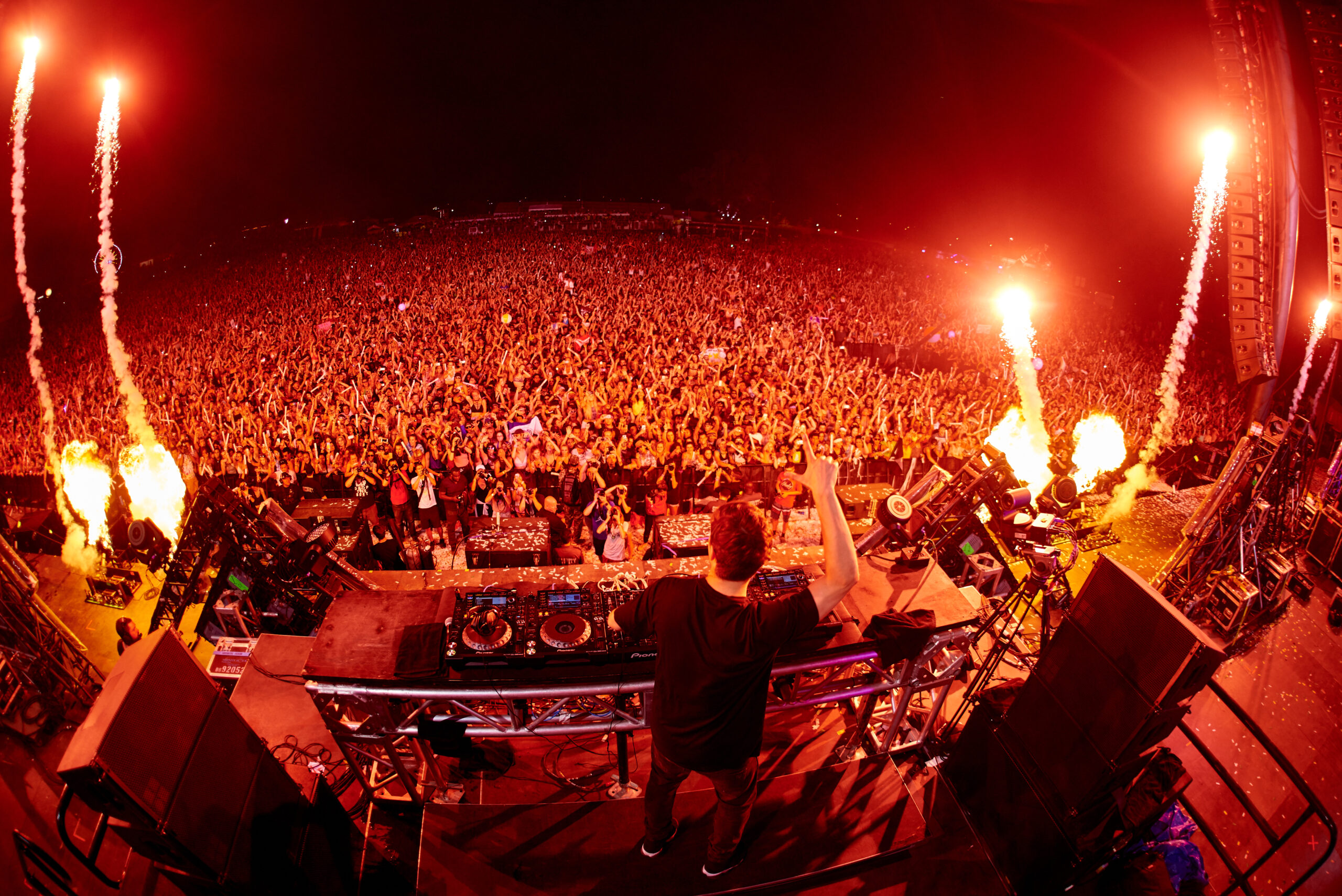
Image: Martin Garrix @ VELD Festival.jpg | https://www.flickr.com/photos/149801000@N05/34735181834/ | License: CC BY-SA 2.0 | Source: Wikimedia | https://commons.wikimedia.org/wiki/File:Martin_Garrix_@_VELD_Festival.jpg