The Sound Design of 90s Rock: The Producers Who Made the Decade Hit Harder
The biggest 90s rock records were engineered as much as they were written. From punchy drum rooms to saturated guitars and radio-ready vocal chains, these producers defined the era’s sonic identity.
When people talk about 90s rock, they usually start with the bands: Nirvana, Pearl Jam, Stone Temple Pilots, Red Hot Chili Peppers, Foo Fighters, Soundgarden, Alanis Morissette. But the sound that made those records cut through car stereos, MTV, and FM radio had a lot to do with the producers behind the console. These were not passive documentarians. They were tone architects, arrangement editors, and mix decisions made in real time.
The best 90s rock producers understood a brutal truth about the decade: heavy guitars alone were not enough. A hit needed impact, clarity, and a specific kind of emotional tension. That meant drums with room and attitude, guitars that were wide but never muddy, vocals that sounded raw without disappearing, and mixes that translated from cassette decks to CD players to club PA systems.
Butch Vig: The Precision Engine Behind Grunge’s Mainstream Breakthrough
Butch Vig’s work on Nevermind is one of the defining production turns in rock history. Before that record, grunge was still largely coded as underground. Vig and mixer Andy Wallace gave Nirvana a sonic frame that could survive on alternative radio and still hit like a sledgehammer.
The core of the sound is deceptively simple: tight drums, heavily layered guitars, and a vocal chain that makes Kurt Cobain feel both distant and immediate. Vig has spoken often about capturing powerful performances while preserving dynamics, and that balance matters. Dave Grohl’s drums are huge not because they’re overloaded with processing, but because the room, tuning, and performance are all aligned. The snare has crack, the kick has enough low-end weight to anchor the choruses, and the cymbals are present without smearing the mix.
For producers today, the lesson is not “make everything louder.” It is to create contrast. Verse guitars can sit narrower and more restrained, while the chorus opens up with doubled rhythm parts and a bigger cymbal image. Vig’s era-defining trick was making heavy music feel larger by arranging space, not just piling on gain.
Brendan O’Brien: The Radio-Ready Punch of Pearl Jam, Stone Temple Pilots, and Beyond
If Butch Vig made grunge explode, Brendan O’Brien helped polish rock into a form that could dominate the entire decade. His fingerprints are all over records by Pearl Jam, Stone Temple Pilots, Soundgarden, and later Foo Fighters. O’Brien’s production style is about propulsion. The tracks move. The drums sit forward. The guitars are muscular but controlled. The vocal rides are carefully shaped so choruses lift without becoming glossy.
Listen to Pearl Jam’s Vs. and you hear a band that still feels volatile, but with the kind of low-end discipline major-label rock demanded. O’Brien often favors a strong center image and an aggressive midrange, which is crucial in rock mixes where guitars occupy a huge frequency block. Instead of letting everything pile up around 200–500 Hz, he tends to give instruments distinct lanes. That is why his mixes feel dense but readable.
A useful takeaway for modern sessions: if your rock arrangement feels powerful in the room but thin on playback, it may not need more plugins. It may need better part separation. Trim overlapping guitar voicings, simplify bass movement under the vocal, and let the kick claim one clear pocket. O’Brien’s records rarely sound overworked because the arrangement already does a lot of the lifting.
Bob Rock: Stadium Scale, Huge Drums, and the Art of Making Bands Sound Larger Than Life
Bob Rock brought a different kind of 90s power: blockbuster scale. His work with Metallica, Mötley Crüe, and The Cult showed how massive a rock record could sound when the drums were treated like the foundation of a building. Even when his production style sparked debate, it was unmistakably effective.
Rock is associated with very large-sounding drum capture, thick low end, and an emphasis on impact that can feel cinematic. The snare often sounds expensive before the rest of the mix even enters. He understood that a band can sound bigger when the drums are not just tight, but authoritative. That means controlled sustain, careful phase alignment, and the willingness to use room microphones as an active part of the record’s identity.
For producers and engineers, Rock’s influence is a reminder that size is a choice. If you want stadium energy, think in envelopes: how fast does the kick speak, how long does the snare ring, how much room tone is too much, and where does the bass live relative to the toms? A “big” mix is usually the result of disciplined decisions, not just boosted lows.
Rick Parashar: The Warm, Organic Gravity of Pearl Jam and Temple of the Dog
Rick Parashar’s production on Ten and Temple of the Dog helped define a more organic, emotional side of 90s rock. Where some producers chased maximum radio impact, Parashar preserved the feel of a band playing in a room while still giving the records enough weight to compete commercially.
His mixes tend to have a tactile warmth: guitars feel textured rather than hyper-edited, drums breathe, and vocals sit in a natural pocket instead of being over-sculpted. That sense of space is part of why those records still feel alive. The ambience is not an afterthought; it is part of the emotional language.
Modern producers can borrow from this approach by resisting the urge to sterilize tracks. Leave a bit of amp fizz if it adds urgency. Keep room tone if it helps the vocal feel human. Use saturation and subtle compression to glue a performance together rather than flattening it into a grid. Parashar’s legacy is proof that polish and intimacy are not opposites.
What Actually Made 90s Rock Productions Work
The most durable 90s rock hits share a few technical traits. First, the drum sound is almost always decisive. Whether it is dry and punchy or big and roomy, the drum kit establishes the record’s physical scale within seconds. Second, guitars are arranged as architecture rather than constant noise. They are layered, panned, and EQ’d to leave room for vocals and snare transients. Third, the lead vocal is treated as the emotional center, even when it sounds ragged or unpolished.
There is also a tonal bias in much of the decade: upper-mid bite without harshness, low-end thickness without sub-bass bloat, and enough compression to keep the record exciting without choking the dynamics. This is where 90s rock differs from many modern productions. Today, it is common to chase hyper-clarity and ultra-controlled transients. The best 90s rock mixes often sound more physical because they allow a little more air movement, a little more amp noise, and a little more natural grit.
Gear and Workflow Lessons Producers Still Use Today
Even if you are working entirely in a DAW, the 90s rock playbook still holds up. Start with drum editing philosophy, not editing for its own sake. If the performance has feel, preserve the relationship between kick, snare, and overheads. Use room reverb sparingly but intentionally. Try compressing parallel drums hard enough that the shells feel like they are leaning forward, then blend that under the dry kit for weight.
For guitars, build width through performance and arrangement before reaching for stereo wideners. Double-track with conviction. Slight variations in picking pressure, amp tone, and mic position matter more than plugins designed to fake size. A classic 90s rock guitar tone often came from a real amp, a dynamic microphone, and careful blending of close and room capture. That chain still works because it obeys the physics of the instrument.
Vocals are where many modern mixes can learn the most from 90s rock. The right chain is usually less about pristine transparency and more about presence under pressure: a compressor that tames peaks, a second stage for density, and EQ moves that keep the vocal forward without making it brittle. Distortion, when used subtly, can help a vocal sit in front of loud guitars without simply turning it up.
The Producers Behind the Era Were Sound Designers Before the Term Was Cool
The phrase “sound design” is often reserved for electronic music, but 90s rock producers were doing sound design every day. They were designing the emotional impact of a snare hit, the width of a chorus, the way a vocal sounded when it broke, and the amount of air around a power chord before it collapsed into feedback.
Butch Vig made underground angst commercially undeniable. Brendan O’Brien translated raw energy into radio dominance. Bob Rock turned rock into a stadium-sized event. Rick Parashar proved that warmth and realism could still be enormous. Different aesthetics, same mission: make the song feel bigger, sharper, and more memorable than the band alone could achieve in a room.
That is the real legacy of 90s rock production. The decade’s biggest records did not just document performances. They shaped them into sound worlds. And if you are producing rock today, that is still the goal worth chasing.
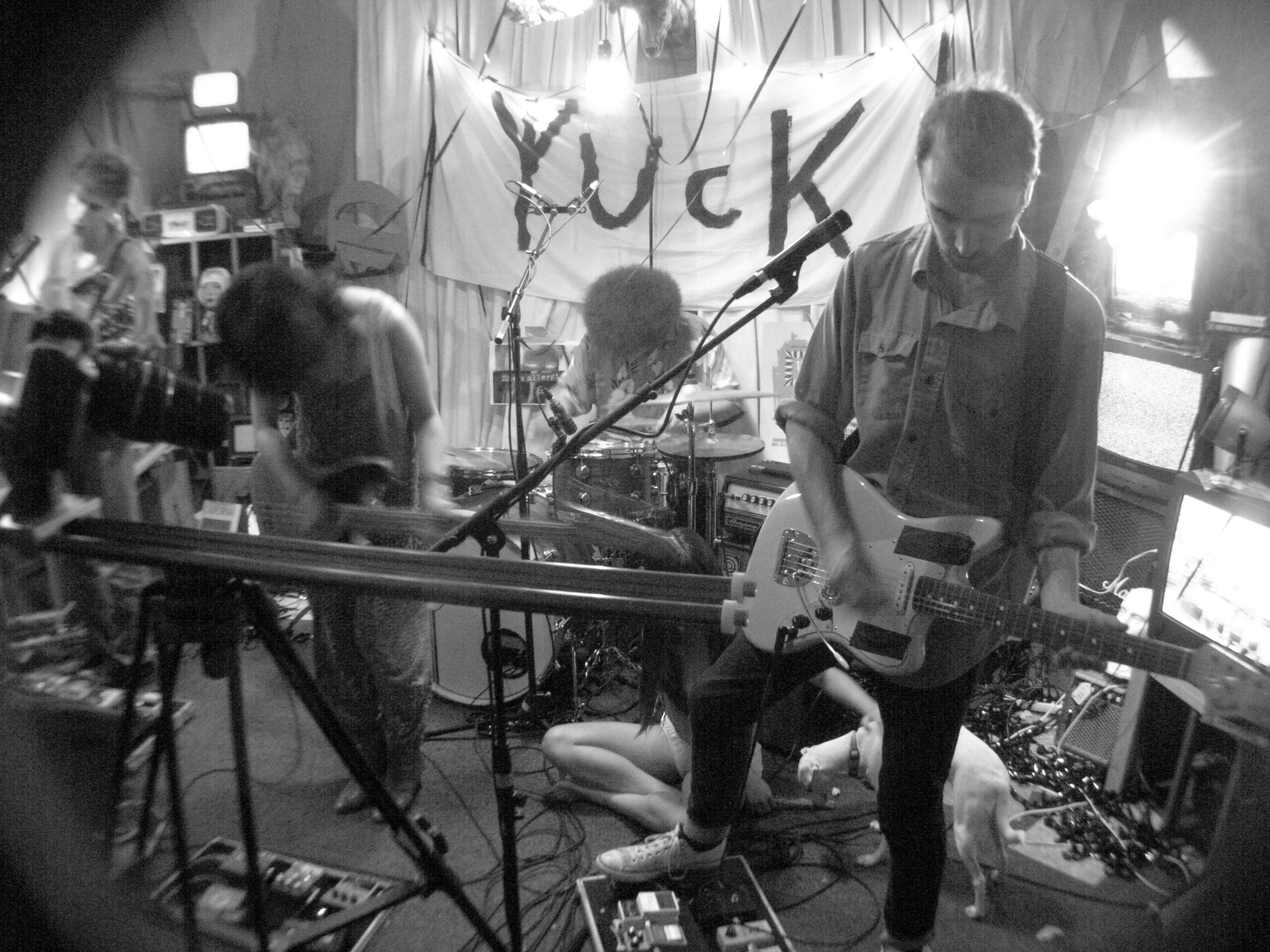
Image: Yuck, Room 205, 2011.jpg | https://www.flickr.com/photos/goincase/6130404195/ | License: CC BY 2.0 | Source: Wikimedia | https://commons.wikimedia.org/wiki/File:Yuck,_Room_205,_2011.jpg