Inside Depeche Mode’s Producer Chain: The Sonic Decisions That Made the Band Sound Unmistakable
Depeche Mode’s identity was never just a band signature—it was built by producers who understood space, contrast, and tension as technical tools. From early synth-pop precision to later industrial weight, this is the production blueprint behind their sound.
Depeche Mode have one of the most durable signatures in modern music, but that signature was never a fixed preset. It was assembled, refined, and repeatedly pressure-tested by a succession of producers who understood that the band’s power lived in arrangement, texture, and restraint as much as in melody. If you want to understand why Depeche Mode still feel technically distinct decades later, you have to look at the production decisions: which drums were allowed to punch, which synths were left cold, when distortion was introduced, and how much empty space was left around Dave Gahan’s voice.
That evolution is a useful case study for producers because it shows how sonic identity is built through consistent choices rather than one magic sound. Depeche Mode’s production history is not a straight line from “synth-pop” to “industrial.” It’s a sequence of lessons in minimalism, machine groove, harmonic tension, and controlled abrasion.
Daniel Miller and the early discipline of electronic pop
Depeche Mode’s earliest records were shaped by Daniel Miller, founder of Mute Records, who helped define the band’s clean, mechanical, and highly disciplined early aesthetic. On albums like Speak & Spell and the early singles era, the production goal was clarity. The synth parts were direct, the rhythms were tidy, and the arrangements avoided clutter. That mattered because the band’s songwriting at that stage was simple and melodic; the production had to create identity without crowding the hooks.
The technical language here is important. Early Depeche Mode leaned on bright analog synth lines, crisp sequenced patterns, and relatively dry drum-machine programming. Instead of masking the machinery, Miller framed it. You can hear the space between elements—the notes don’t smear together, and the percussion doesn’t bloom into a wash. That dryness made the songs feel like they were built from labeled components, which in turn gave the band a recognizable aesthetic almost immediately.
For producers today, the lesson is that “primitive” electronic production can actually be a strength if the arrangement is clean enough to let each part function like a graphic element. A small palette, when handled well, can sound more authoritative than a busy one.
Gareth Jones and the move from pop precision to atmospheric architecture
If Daniel Miller helped establish Depeche Mode’s machine-pop foundation, Gareth Jones helped expand the room around it. His work on key records in the mid-to-late 1980s, including the era around Black Celebration and Music for the Masses, pushed the band toward darker textures and more cinematic scale. This was a crucial turning point: Depeche Mode stopped sounding like a synth-pop act with good songs and started sounding like a fully realized sonic world.
Jones’s production approach favored atmosphere, depth, and contrast. Reverbs were larger, synths were more textural, and the low end became more central to the emotional weight of the tracks. The key move was not simply “making it bigger.” It was introducing a controlled sense of emptiness. The band’s arrangements began to breathe in a more dramatic way, which made the choruses hit harder and the darker material feel even more severe.
That kind of production is a masterclass in negative space. When a track is too dense, the emotional impact disappears. Jones understood that a synth bed becomes more ominous when it’s not fully continuous, and that percussion feels more urgent when its transients are allowed to cut through a darker backdrop. Depeche Mode’s sound became less about sheen and more about pressure.
Alan Wilder: producer, arranger, and the architect inside the band
Alan Wilder is impossible to separate from Depeche Mode’s production identity, even when the credits tell only part of the story. As a band member and increasingly influential sonic architect, Wilder brought a producer’s ear to arrangement, sampling, and structural detail. His impact is especially visible in the records where the band’s sound became more muscular, more sample-driven, and more emotionally severe.
Wilder’s genius was in turning source material into new language. Rather than treating samples as decorative additions, he used them as compositional building blocks. Percussion could be constructed from nontraditional sources, hits could be layered for impact, and loops could be used to create a sense of forward motion without resorting to conventional rock drumming. This is one reason Depeche Mode’s middle-era records feel so texturally dense even when the arrangements are relatively sparse: the density is in the sound design, not just the note count.
He also had a clear sense of contrast. Clean synths would sit against distorted elements. Tight sequences would coexist with decaying ambience. The result was a production style that made emotional extremes feel natural. If Miller’s early work gave Depeche Mode discipline and Jones gave them scale, Wilder gave them weight.
For modern producers, Wilder’s approach is a reminder that sampling is not just about quotation or nostalgia. It can function as a method of re-engineering rhythm, tone, and tension from the ground up. That mindset is especially relevant in DAW-based production, where it’s easy to collect sounds but harder to assign them structural purpose.
Flood and the industrial edge of controlled excess
Flood’s work with Depeche Mode helped sharpen the band’s 1990s identity into something more physically imposing. By the time the group entered the period around Violator and beyond, the production emphasis had shifted toward a hybrid language: electronic music with rock-scale impact. Flood understood how to make synths feel heavy, drums feel aggressive, and vocals sit in a mix without losing vulnerability.
What makes this era so technically interesting is the combination of polished mixing and abrasive content. The records are not lo-fi, but they are not glossy in a conventional pop sense either. Distortion is used as flavor, not just as saturation. Drums are often compressed to create a sense of density and momentum. Synth bass and midrange layers are arranged to occupy emotional, not just frequency, territory.
This is where Depeche Mode became a production reference point for everyone from alternative rock bands to industrial acts. Flood’s mix choices let the band sound massive without erasing the electronic core. The tracks often feel built to survive on headphones, club systems, and large PA rigs simultaneously. That’s not an accident; it comes from careful attention to transient balance, low-end architecture, and midrange aggression.
Ben Hillier and the modernization of the band’s palette
Later-era Depeche Mode production, including the work with Ben Hillier, shows a different kind of challenge: how do you modernize an established sonic identity without turning it into a museum piece? Hillier’s approach was less about recreating classic Depeche Mode textures and more about recontextualizing them for contemporary production standards.
That meant cleaner top-end, more current drum treatment, and a slightly more open, less claustrophobic mix aesthetic. The band’s familiar traits were still present—dark harmonies, machine rhythm, emotional gravity—but the workflow favored sharper separation and a more modern low-end footprint. In practical terms, that is often the hardest production task in catalog acts: preserving the DNA while updating the camera lens.
Hillier’s era illustrates a useful principle for producers working with legacy sounds. You do not need to over-quote the past for an artist to feel like themselves. Sometimes the strongest move is to preserve the harmonic and emotional behavior of the music while changing the mic choices, drum shaping, and mix topology around it.
Why Depeche Mode’s sound works: technical constants across different producers
Across all these eras, Depeche Mode’s identity stays coherent because the production repeatedly protects a few core ideas. First, the band nearly always leaves room for the vocal to feel like a focal object rather than a layer in the texture. Even when the arrangements are huge, Dave Gahan’s voice is framed with intention, often surrounded by atmosphere instead of buried in it.
Second, the rhythm programming favors momentum over flash. Whether the foundation is drum machine, sampled percussion, or hybrid treatment, the groove tends to feel disciplined and emotionally loaded. There’s rarely any sense that percussion exists just to show off sound design.
Third, the tonal palette is built on contrast: clean against dirty, synthetic against human, bright against shadowed. That contrast is the real Depeche Mode “sound,” more than any single synth model or preset. The producers who worked with the band understood that their strongest material lives in that tension.
Production takeaways you can actually use
If you’re trying to borrow from the Depeche Mode production mindset, start with arrangement before sound selection. Build fewer parts, then make each one do a more specific job. A synth line should either create motion, define harmony, or supply texture—but ideally not all three at once. That kind of separation is what gives the music its architectural feel.
Next, treat ambience as composition. Reverb and delay should not only create depth; they should shape emotional scale. A short, hard room can make a drum machine sound tense. A longer, darker plate can turn a simple vocal into a confession. Use space intentionally, not decoratively.
Finally, do not confuse density with impact. Depeche Mode’s best records are often surprisingly economical in parts, even when they sound huge. The size comes from contrast, frequency control, and the discipline to let elements feel isolated when that isolation improves their psychological effect.
That is the real lesson from the producers behind Depeche Mode’s sound: technical choices are never just technical. In the right hands, they become identity.
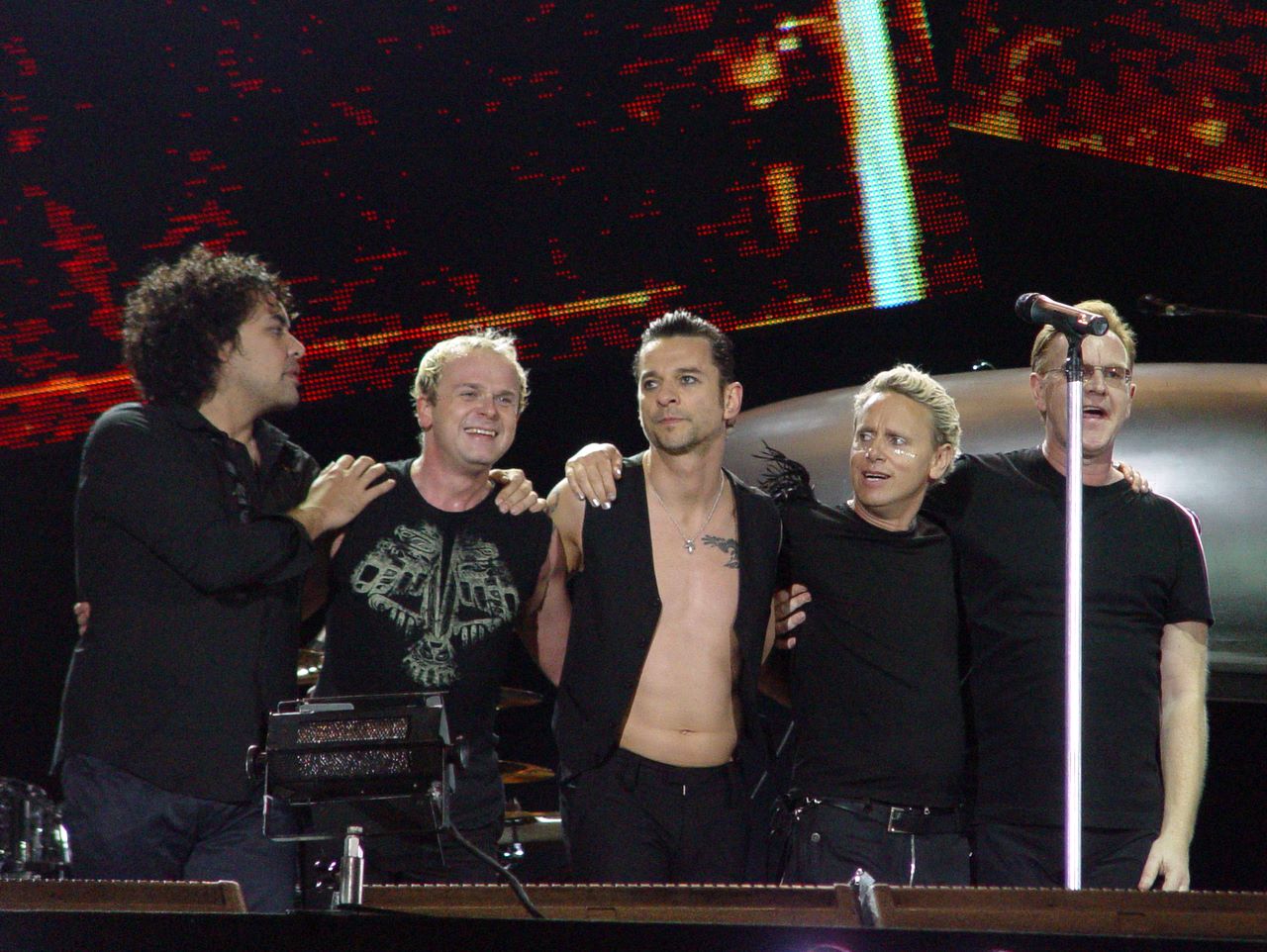
Image: Tierecke dm.jpg | Self-photographed | License: CC BY-SA 2.5 | Source: Wikimedia | https://commons.wikimedia.org/wiki/File:Tierecke_dm.jpg