Best Studio Monitors for Small Rooms in 2026: What Actually Works on a Tight Desk
Small rooms expose monitor problems fast, which is why the best picks for 2026 are less about raw power and more about controlled low end, clean midrange, and placement flexibility. Here’s how the right nearfield monitor fits into a real production workflow—and which models make the most sense on a cramped desk.
Why Small-Room Monitoring Is a Different Problem
A small studio changes everything. The monitor that sounds expansive in a treated control room can become a liability on a bedroom desk if its low end overwhelms the space, its rear port fights the wall, or its tweeter throws a harsh top end straight at your ears. In a tight room, the goal is not the loudest monitor or the one with the biggest woofer. The goal is the monitor that gives you the most usable translation at close range.
That is why the best studio monitors for small rooms in 2026 are not necessarily the most expensive. They are the ones that stay honest at lower listening distances, minimize boundary issues, and let you make decisions quickly without second-guessing every kick drum or vocal EQ move. If your room is untreated or only lightly treated, that matters even more. A smart monitor choice can do more for your mixes than a pile of plugins.
What to Look for in a Monitor for a Tight Space

Before getting into specific models, it helps to define the real-world criteria. In a small room, a good monitor should have:
- Controlled bass extension so you are not fighting room modes below 100 Hz.
- Clear midrange for vocal balance, snare tone, synth layers, and guitar separation.
- Good off-axis behavior so small head movements do not radically change the tonal balance.
- Front-porting or flexible boundary tuning if the speakers need to sit close to a wall.
- Low listening fatigue for long edit and mix sessions at modest volume.
The big decision is usually 5-inch versus 7-inch. In a truly small room, a well-designed 5-inch monitor is often the safer bet. A 7-inch can be excellent if the room is treated and the placement is disciplined, but a larger woofer can excite the room too much if the desk is jammed into a corner. For many producers, the best setup is a pair of accurate 5-inch monitors plus a trusted headphone check for sub-bass validation.
The Best Studio Monitors for Small Rooms in 2026

1. Neumann KH 80 DSP
The KH 80 DSP remains one of the strongest small-room choices because it is built around control. It is compact, highly detailed, and exceptionally consistent at nearfield distances. The DSP management is not just a marketing checkbox; it helps the speaker adapt to placement realities in smaller studios, which is exactly where many buyers need help.
Why it works in a small room: the KH 80 is tight in the low end, precise through the mids, and revealing without sounding hyper-etched. If you are doing vocal production, beat arrangement, or detailed editing, it makes compression and EQ decisions easier because it does not exaggerate bass bloom or hyped treble.
Best for: producers who want a truthful reference monitor for close-range work and can benefit from room correction tools.
2. Genelec 8330A
Genelec’s 8330A is a favorite in compact studios for good reason. It offers impressive imaging, strong low-end discipline for its size, and integration with GLM room correction, which can be a major advantage if your room is imperfect. In small spaces, that calibration workflow can reduce the guesswork that often leads to overmixing bass or carving too much out of the low mids.
What stands out is translation. The 8330A gives you a stable center image and a strong sense of depth, so panning and reverb placement feel more deliberate. It is one of those speakers that helps you hear whether a mix is actually balanced or just loud.
Best for: engineers and producers working in compact rooms that need calibration support and reliable stereo imaging.
3. Kali Audio IN-5
The IN-5 is a standout value pick because it delivers a coaxial-style imaging experience and a broader sweet spot than many budget monitors. In small rooms, that matters. If your listening position shifts a little during editing, arrangement, or MIDI programming, the IN-5 stays impressively stable.
Its sound is open and present, with a midrange that makes vocals and synths easy to place. The low end is more than adequate for a 5-inch class monitor, but it still behaves like a sensible choice for a tight room rather than trying to brute-force sub-bass it cannot physically deliver.
Best for: home producers who want excellent imaging and a strong mix tool without stepping into premium pricing.
4. Adam Audio A4V
If your room is very tight and you need something compact but still serious, the A4V deserves attention. Adam’s ribbon tweeter design has long been associated with a detailed top end, and in the A4V that clarity is useful for hearing transients, hat patterns, reverb tails, and vocal air. The key is that the monitor is small enough to fit sensible desk setups without dominating the room.
The A4V is especially appealing for electronic producers, mix editors, and anyone who works heavily with transient-rich material. The high-frequency detail can speed up editing decisions, though some users may prefer to cross-check for brightness if they are used to darker monitors.
Best for: compact workstations, electronic production, editing, and detail-oriented mixing.
5. Focal Alpha 65 Evo
The Alpha 65 Evo is the option on this list that gives you a little more scale without going overboard. In a small room that is at least somewhat managed, it offers a full-range feel that can be helpful if you produce bass-heavy music and want a monitor that still reads kick weight and low mids confidently.
The important caveat is placement. This is not the kind of monitor you should push against a wall and hope for the best. But if you can give it breathing room, the Alpha 65 Evo can be a practical middle ground between compact nearfield behavior and enough bandwidth to make arrangement and balance decisions without constantly living on headphones.
Best for: producers who need a slightly larger monitor but still want small-room sanity.
6. IK Multimedia iLoud MTM MKII
For ultra-small rooms, the iLoud MTM MKII is one of the smartest designs on the market. Its vertical MTM format is built around controlled directivity, which helps reduce the impact of early reflections from the desk and nearby walls. That design choice is not just theoretical; it can make a real difference when your setup is squeezed into a corner or pushed close to a wall.
The iLoud MTM MKII is particularly useful for production-focused workflows where you need repeatable results at short distance. It also supports room correction, making it appealing for apartment setups and untreated spaces where traditional monitors can feel unruly.
Best for: very small desks, portable studios, and users who need help controlling reflections.
5-Inch vs 7-Inch: The Practical Answer
In a small room, bigger is not automatically better. A 7-inch monitor can sound more complete, but it also increases the chance that the room will dominate the sound. That usually shows up as muddy bass, smeared kick definition, or inconsistent low mids depending on where you sit. If your room is under about 120 square feet and only lightly treated, a quality 5-inch monitor is usually the safer move.
If your room is treated with bass trapping and you can place the monitors properly—tweeters at ear height, equilateral triangle, away from corners—a 7-inch model can work beautifully. But the room has to earn that upgrade. Otherwise, you may spend more time compensating for the room than making music.
How These Monitors Fit Into a Real Workflow
The best monitor is the one that helps you move through the production process with less friction. In a small room, that typically means:
- Writing and arranging: clear midrange helps you judge whether the vocal or lead is competing with the track.
- Editing: accurate transients make it easier to clean up clicks, tighten drums, and balance layers.
- Mixing: stable imaging helps with panning, depth, and automation choices.
- Low-end checks: disciplined bass response keeps you from overcompensating with EQ or saturation.
In practice, many producers in small rooms work best with monitors at moderate volume, then use headphones to inspect sub information and stereo effects. That workflow is not a compromise; it is a smart division of labor. Let the speakers handle balance, depth, and tonal perspective. Let the headphones confirm the deep low end and the microscopic details.
Placement Matters as Much as the Monitor
Even the best small-room monitor will disappoint if placement is sloppy. Start with the basics: form an equilateral triangle between your head and the speakers, keep the tweeters at ear level, and avoid putting rear-ported models directly against the wall unless the manufacturer explicitly supports it. If you must place speakers close to a boundary, front-ported designs or monitors with boundary EQ settings are often easier to live with.
Desk reflection is another overlooked issue. A monitor with controlled vertical dispersion, or one mounted slightly above the desk line, can reduce comb filtering and make the center image more stable. In a small room, tiny geometry changes can alter the sound more than a plugin ever will.
The Bottom Line

The best studio monitors for small rooms in 2026 are the ones that respect the room you actually have. For many producers, that means compact, accurate 5-inch models with strong imaging and placement flexibility. If you need calibration and a highly controlled workflow, the Neumann KH 80 DSP and Genelec 8330A are standout choices. If value matters, the Kali IN-5 and Adam A4V offer serious performance without demanding a bigger studio. For very tight setups, the iLoud MTM MKII is one of the most practical answers on the market.
Ultimately, the right choice comes down to your room, your desk, and how you make records. In a small studio, the best monitor is not the one that impresses for five minutes. It is the one that keeps telling you the truth after five hours.
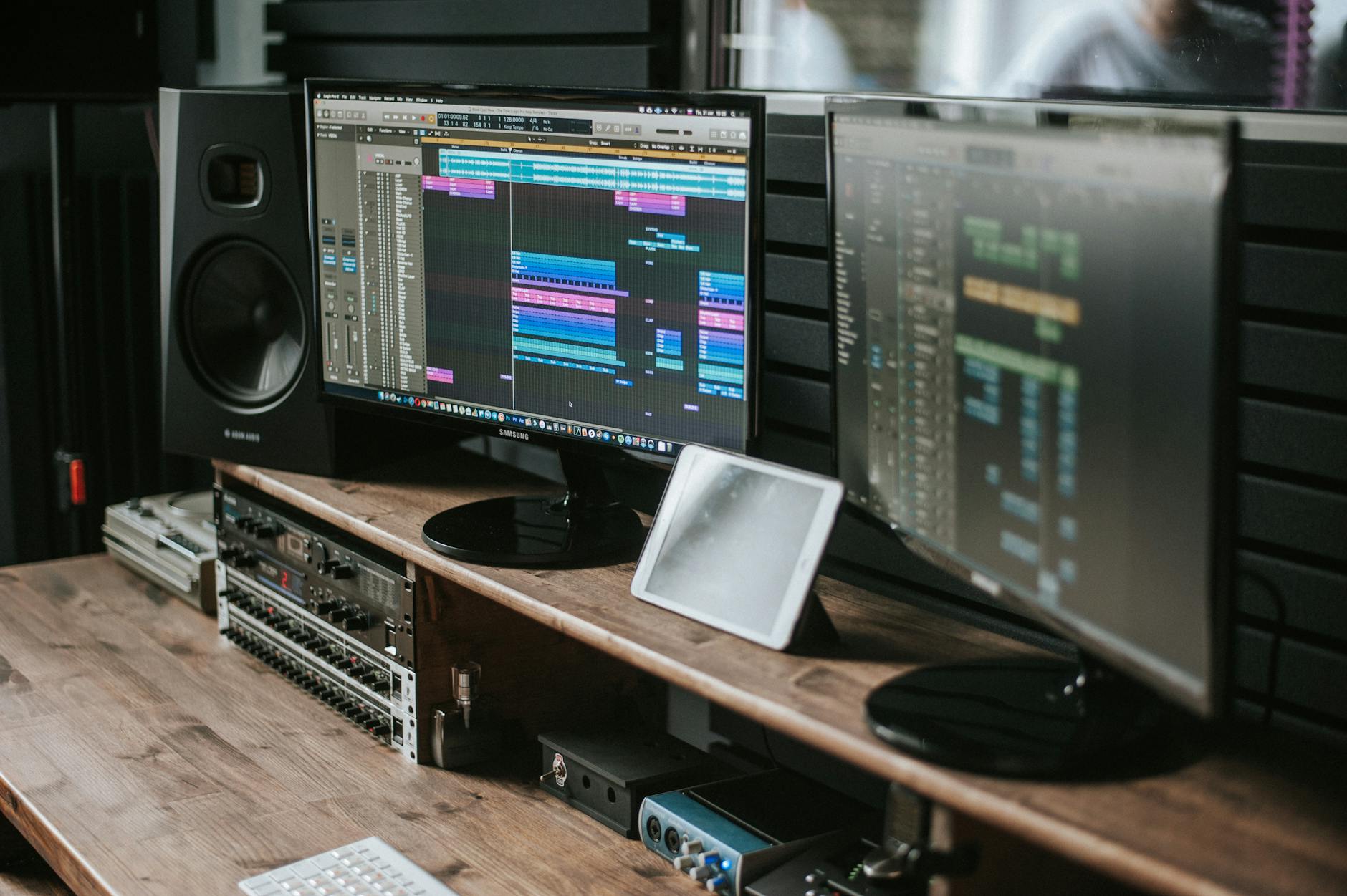
Image: Modern music studio setup featuring dual monitors displaying audio editing software on a wooden desk. | John Taran | License: Pexels License | Source: Pexels | https://www.pexels.com/photo/sound-engineering-software-on-monitors-11044812/