The Producer Signatures That Defined 90s Rock Hits
The biggest 90s rock records weren’t just about riffs and attitude—they were engineered around specific production signatures. From Butch Vig’s layered aggression to Brendan O’Brien’s radio-ready punch, this breakdown traces the arrangement, synthesis, and mix decisions that turned raw bands into era-defining hits.
The 90s Rock Sound Was a Production Decision, Not an Accident
When people talk about 90s rock, they usually reach for the obvious shorthand: bigger guitars, louder drums, more attitude. But the records that defined the decade weren’t just “heavier.” They were built with a very specific production logic. The producers behind those hits understood how to turn a live band into a controlled, repeatable, radio-dominant machine without sanding off the friction that made the songs work in the first place.
The defining 90s rock producer didn’t simply capture a performance. They designed an arrangement around momentum, then used layering, contrast, and mix discipline to make the chorus feel inevitable. In many cases, that meant treating the studio like an instrument: doubling guitars until they formed a wall, tuning drum transients for impact, sneaking synths under distorted instruments, and deciding exactly how much rawness could survive the final mix.
Butch Vig: Layered Aggression and the Illusion of Chaos
If there is one production approach that screams 90s rock precision, it’s Butch Vig’s. His work on Nirvana’s Nevermind is the canonical example of making noisy, emotional material feel both explosive and polished. The trick was never just “make it loud.” It was building depth through stacking, then arranging that depth so the emotional peaks landed harder.
Vig’s workflow often revolved around multi-tracked guitars and carefully controlled drum recording. Instead of relying on one massive take to do all the work, the arrangement is reinforced by redundancy: doubled guitars spread wide, vocal harmonies introduced strategically, and drums captured for both weight and crack. The result is a mix that feels alive but remains legible on radio, where every element needs to fight for space.
From a production standpoint, this is a lesson in controlled density. If your guitars are carrying the song’s aggression, the bass and kick need to be carved so they don’t blur the low end. That often means leaving the sub-bass to the rhythm section and pushing guitars into the low-mid and upper-mid bands where distortion reads clearly. Vig-style production is not about brute force; it’s about making the listener perceive force through organization.
Brendan O’Brien: Radio Punch With Zero Waste
Brendan O’Brien became one of the most important architects of 90s rock because he could turn huge bands into streamlined hit records. His productions for Pearl Jam, Stone Temple Pilots, and others are masterclasses in arrangement efficiency. O’Brien’s records hit hard because every part is doing a job. If a guitar riff doesn’t move the song, it gets simplified. If a chorus needs lift, background vocals, tambourines, or octave layering may be introduced with surgical timing.
His mixes tend to emphasize transient clarity and low-end confidence. The snare lands with authority. The kick is felt as much as heard. Guitars occupy a broad stereo field, but they don’t smear into the vocal. That balance is critical in 90s rock, where the vocal had to sound emotionally exposed while still competing with dense instrumentation.
One of the most useful takeaways from O’Brien’s approach is arrangement restraint. He understands that the biggest chorus is not always the busiest one. Sometimes the impact comes from pulling elements away right before the downbeat, then reintroducing them all at once. In production terms, that dynamic contrast often matters more than raw loudness.
Bob Rock: The Arena Rock Architect
Bob Rock’s name is tied to the polished end of 90s rock, especially the period when bands were scaling from club dynamics to arena-sized sonics. His work is about mass, sustain, and command. On records like Metallica’s Black Album and Mötley Crüe’s Dr. Feelgood, Rock pursued a sound that was enormous but disciplined—thick guitars, huge drums, and vocals placed with near-military clarity.
What makes Rock’s productions important to the 90s rock conversation is his use of compression and layering as structural tools. The drums are not just captured; they are shaped. The guitars are not just distorted; they are sculpted to feel like a single unified surface. Even when the performances are aggressive, the mix stays centered and readable. That kind of discipline became a blueprint for mainstream rock radio, where impact had to survive FM compression, cassette duplication, and eventually early digital playback.
For producers, Rock’s catalogue is a reminder that weight comes from consistency. If the kick drum changes tone dramatically from verse to chorus, the foundation feels unstable. If the guitars shift too much in midrange content, the song loses its center. The best arena rock production feels immovable because the tonal picture has been designed to withstand scale.
Rick Parashar and the Warmth of the Pacific Northwest
Not every 90s rock hit relied on polish. Rick Parashar’s productions helped define the warm, organic, slightly sun-bleached character associated with the Seattle and post-grunge era. His work on Temple of the Dog and early Pearl Jam material leans into tone rather than gloss. The drums breathe. The guitars feel wooden and amplified, not surgically isolated. The vocal sits inside the band instead of always floating above it.
That sonic identity matters because it shows another path through 90s rock: emotional realism over hyper-control. Parashar’s mixes often leave more room for room sound, natural decay, and imperfect interplay between instruments. The listener doesn’t just hear the song—they hear the space the band occupies.
In modern production terms, this can be a useful corrective to over-editing. Not every rock record benefits from quantized drums and hyper-aligned doubles. Sometimes the hit record comes from preserving the push and pull of the performance, then using EQ and compression only to clarify it rather than reassemble it.
The Hidden Synth Layer: Small Moves, Big Payoff
One of the most overlooked tools in 90s rock production is synthesis. Even on records that present as “guitar bands,” subtle keyboard or synth layers often reinforce the arrangement. These parts are rarely flashy. They may sit under the chorus, support a pad behind a bridge, or double a melodic line at a low level to create emotional width.
This is where 90s rock production becomes especially sophisticated. A producer might use a synth to extend the sustain of a chorus without making the part obviously electronic. A simple pad can soften the edges of overdriven guitars and keep a dense arrangement from feeling one-dimensional. A mono analog-style bass synth might reinforce a bass guitar to improve translation on smaller systems. The best use of synthesis in rock production is often invisible; you feel its effect before you identify the source.
That invisibility is exactly why these records age well. They don’t rely on a gimmick. They rely on arrangement decisions that increase emotional impact while keeping the band at the center.
What These Producers Actually Did in the Workflow
Across the most important 90s rock records, a few workflow patterns repeat:
- Arrangement before sonics: the song is tightened before the gear makes it louder.
- Layering with purpose: doubled guitars, background vocals, and occasional synths are used to define chorus size.
- Drums built for impact: snare crack, kick definition, and room tone are chosen to survive dense guitar arrangements.
- Mixes that prioritize vocal clarity: even in heavy tracks, the vocal remains emotionally readable.
- Contrast as a hook: verses breathe, choruses expand, bridges shift tone or density.
That workflow is why these records endure. They were not merely recorded; they were designed to move. The producers behind 90s rock hits understood that a great rock record needs both muscle and architecture. Without the architecture, the muscle turns to mud.
The Modern Producer Lesson
If you’re chasing the 90s rock aesthetic today, the goal is not to copy a preset chain or bury everything in distortion. The goal is to build tension through arrangement and then amplify it with disciplined production choices. Start by making the song work on acoustic guitar or piano. Add electric guitars only when they earn their place. Use doubling to widen, not to compensate for weak writing. Let the drums hit hard, but keep the kick and bass speaking different languages. And if you introduce synths, make sure they support the emotional contour rather than announcing themselves as an effect.
The 90s rock producers who mattered most weren’t just great engineers. They were translators. They took bands with volume, angst, and hooks, then turned that energy into records that could survive arena PAs, car stereos, and FM radio. That combination of aggression and control is still the standard.
For producers, that’s the real lesson: the signature sound of 90s rock came from workflow choices. Arrangement. Layering. Contrast. Mix discipline. Those are the tools that turned a generation of loud bands into lasting hits.
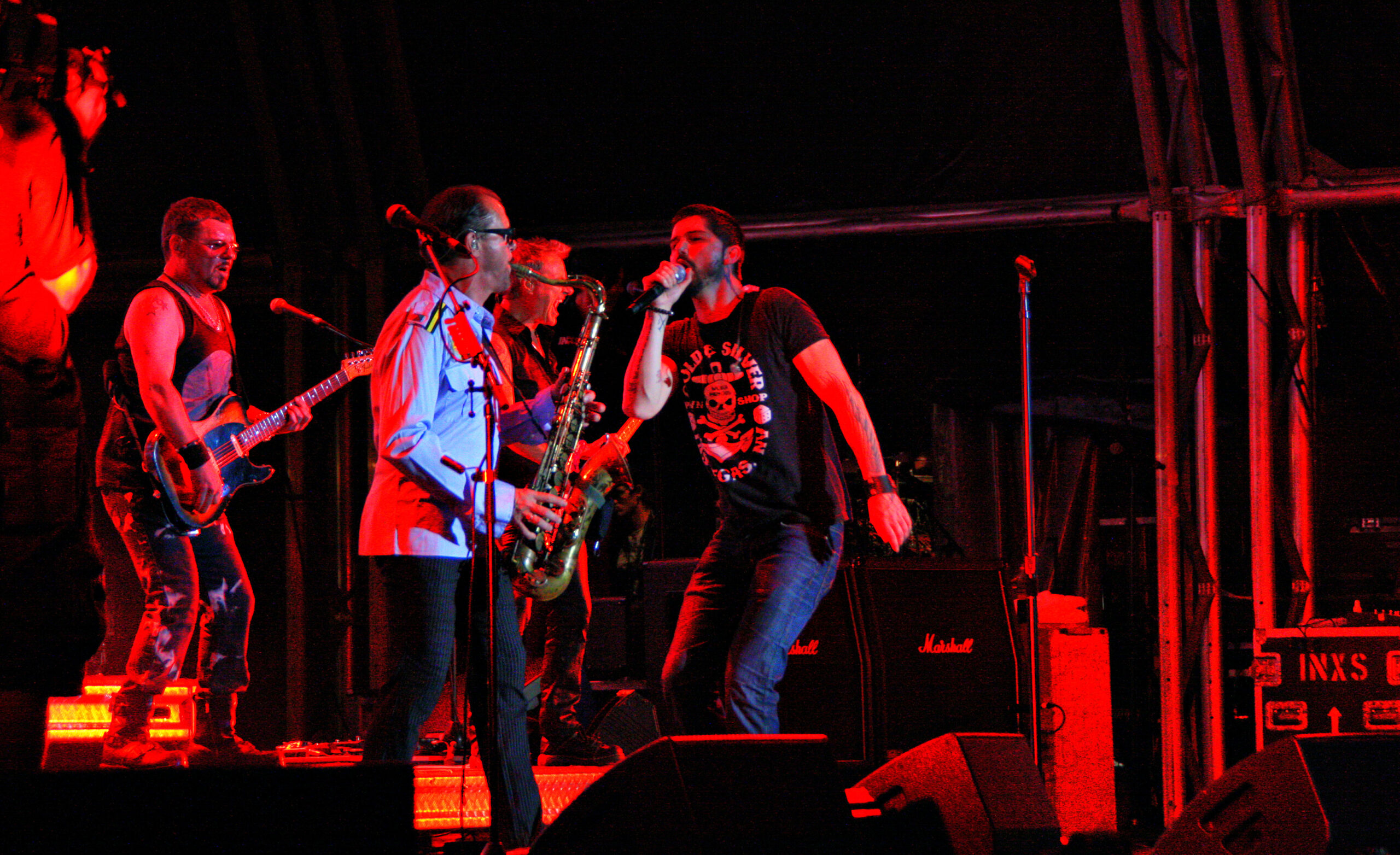
Image: INXS TO ROCK THE HUNTER!.jpg | INXS TO ROCK THE HUNTER! | License: CC BY-SA 2.0 | Source: Wikimedia | https://commons.wikimedia.org/wiki/File:INXS_TO_ROCK_THE_HUNTER!.jpg