The Producers Who Defined the 90s Rock Sound
The biggest 90s rock records were never just about riffs and attitude. They were engineered by producers who knew exactly when to push a band hard, when to strip a mix back, and how to make guitars, drums, and vocals hit with radio-ready force.
The 90s Rock Producer Was Half Engineer, Half Taste-Maker
The defining rock records of the 1990s did not happen by accident. They came from producers who understood that the era’s biggest songs needed contrast: hard-edged guitars that still left room for vocals, drums that felt physical without turning to mush, and mixes that could survive both MTV playback and FM radio compression. The best 90s rock producers were not simply capturing bands; they were shaping identity.
If you listen closely to the decade’s biggest rock hits, you can hear a handful of recurring production decisions. The snare is often tuned and gated for impact but not deadness. The rhythm guitars are doubled, sometimes quadrupled, and kept wide but controlled. Bass is either thick and supportive or intentionally raw and clanky depending on the aesthetic. Vocals are present, forward, and usually treated with just enough compression to feel intimate under heavy instrumentation. Those choices are the real story behind the sound.
Brendan O’Brien: Modern Weight Without Losing the Band
Brendan O’Brien became one of the defining producers of 90s rock by finding the sweet spot between punch and clarity. His work with Pearl Jam, Stone Temple Pilots, and later the Red Hot Chili Peppers is a masterclass in making rock feel big without flattening the performance into generic polish. O’Brien’s records often sound like the band is playing in a room, but the room has been carefully edited to prioritize impact.
Producer takeaway: O’Brien-style mixes often rely on strong arrangement discipline. If guitars, bass, and drums all occupy the same midrange lane, the mix will feel crowded no matter how expensive the gear is. His sound benefits from aggressive editing of low-end overlap, layered guitar parts with distinct roles, and drums that are recorded to sound exciting before processing. For modern sessions, that means choosing parts that complement each other rather than stacking similar tones.
Listening cue: Notice how the drums feel huge but rarely swamp the vocal. That usually comes from a combination of solid overhead capture, close mic compression, and careful automation rather than one dramatic plugin setting.
Bob Rock: Stadium-Sized Guitars and the Art of Controlled Excess
Bob Rock helped define the larger-than-life side of 90s rock production. His approach is often associated with massive drum sounds, broad guitar walls, and a sense that every element has been built to survive a giant system. The famously huge records he cut with Metallica, Mötley Crüe, and other hard rock acts show a producer obsessed with scale, low-end authority, and undeniable front-to-back power.
What makes Rock’s production interesting is that it is not just “loud.” It is structured. Guitars are usually layered in ways that create width and density without collapsing into an indistinct block. Drums are tuned and captured to emphasize punch at the point of impact, which is one reason the snare on many of these records feels like it lands a half-second in your chest. Bass is often locked tightly to the kick, giving the mix a foundation sturdy enough to support very dense arrangements.
Producer takeaway: If you want this style of rock weight, start with the arrangement. Use fewer active parts in the verse, let the chorus open up with additional guitar layers or cymbal energy, and compress with intention rather than reflex. A great Bob Rock-inspired mix is not about slamming every bus to death; it is about making the loud moments feel bigger because the song has room to breathe.
Butch Vig: Grunge as Design, Not Accidental Chaos
Butch Vig’s work with Nirvana, Smashing Pumpkins, and Garbage proves that some of the heaviest cultural shifts in rock came from highly deliberate studio thinking. The myth around 90s alternative rock often suggests rawness and spontaneity, but Vig’s productions are meticulously constructed. He knows how to preserve edge while still building records that can translate everywhere from car stereos to arenas.
On Nevermind, the famous drum sound alone tells the story: the kit is bright, punchy, and engineered for contrast, not realism. Vocals sit forward enough to carry melody, but the guitars still feel ragged and energized. That balance is central to the decade. Vig’s productions often let distortion feel emotional rather than abrasive. The band sounds loose, but the record is tightly managed.
Listening cue: Pay attention to the way the verse and chorus dynamics are exaggerated through production decisions. Often it is not just a volume lift. It is a shift in cymbal density, guitar layering, and compression behavior that makes the chorus appear to jump forward.
Producer takeaway: For modern rock sessions, this means being very deliberate about section contrast. Automate your drum room send, vary the distortion texture between sections, and do not assume that “raw” means unprocessed. A controlled amount of imperfection usually sounds bigger than an untreated live take.
Steve Albini: The Sound of the Room Being the Point
Steve Albini sat at the opposite end of the spectrum from the era’s more polished radio rock producers, but his influence on 90s rock is impossible to ignore. His philosophy centered on capturing bands honestly, with minimal interference and maximum room character. Records like In Utero and his broader work with rock and indie bands gave the decade a different kind of heaviness: not the gloss of arena rock, but the physical reality of musicians playing together.
Albini’s productions emphasize transient detail, natural ambience, and the sonic fingerprint of the recording space. Guitars can sound harsher, drums more unvarnished, and vocals less processed. The appeal is not convenience or radio smoothness; it is impact through realism. In an era increasingly dominated by layered production, that approach was a corrective.
Producer takeaway: To borrow from this philosophy, stop over-fixing the source. Choose the right room, let overheads and room mics do real work, and avoid excessive corrective EQ that strips away character. If your kit sounds good in the room, an honest recording path may beat a heavily “improved” one.
Andy Wallace: The Mix Engineer Who Turned Density Into Clarity
Andy Wallace is one of the most important names in 90s rock sonics because he solved a problem every producer was facing: how to make dense, aggressive records sound clear on radio and on headphones. His mixing work helped define the polished end of alternative and hard rock, where power had to coexist with articulation.
Wallace’s signature often lies in the balance of transients and controlled sustain. Drums hit hard without turning into a wash. Guitars are big but carved. Vocals are centered and intelligible, even in huge arrangements. This is the kind of mix that reveals why engineering matters as much as tone selection. Two bands can use similar amps, drums, and microphones, but the mix decisions will determine whether the record feels professional or merely busy.
Producer takeaway: Wallace-style clarity usually comes from disciplined EQ moves, strong compression staging, and ruthless frequency management between instruments. If your guitars are masking vocal presence around 2–4 kHz, don’t just turn up the vocal; create space. If the kick and bass are fighting, decide who owns the sub region and who owns the attack.
Sylvia Massy: Experimentation That Still Served the Song
Sylvia Massy brought a different kind of energy to 90s rock production: experimentation with texture, room sound, and nontraditional recording approaches, while still keeping the song at the center. Her work showed that rock records could be inventive without becoming self-indulgent. She helped make sonic quirks feel like part of the arrangement rather than novelty decoration.
Producer takeaway: Massy’s legacy is a reminder that unusual mic placement, re-amped textures, distorted ambience, or unconventional recording spaces can add personality fast. The key is intent. A strange guitar texture should answer a musical problem—depth, contrast, or attitude—not exist just because it is unusual.
Practical Lessons for Modern Producers Chasing 90s Rock Energy
The biggest lesson from 90s rock producers is that tone is only one part of the equation. The records that endure are built on strong performance capture, section contrast, and mix hierarchy. If you want to approximate the sound in a modern session, start here:
- Track performances like they matter. Tight playing and committed takes do more than endless plugin chains.
- Use layered guitars with purpose. Pan complementary tones instead of stacking identical tracks.
- Let drums breathe. Room mics and controlled compression often matter more than sample replacement.
- Prioritize vocal intelligibility. A great 90s rock chorus usually keeps the lyric front and center.
- Use automation aggressively. Volume rides, send changes, and section-specific effects were part of the sound.
For plugin users, that often means less “vintage emulation” and more smart workflow: fast EQ cleanup, bus compression with modest gain reduction, room-style reverbs that are short and believable, and saturation used to help elements sit together rather than smear them. The 90s rock sound was not one preset. It was a series of decisions about energy, depth, and how much control the producer wanted over chaos.
Why These Producers Still Matter
90s rock remains a reference point because its producers understood scale without sacrificing identity. They made records that felt larger than the room they were tracked in, but still sounded like bands with specific personalities. Whether the approach was polished, raw, bombastic, or experimental, the common thread was authority: every decision served the song’s emotional punch.
For modern producers, that is the real lesson. The most enduring rock records are not just loud, and they are not just “organic.” They are designed. The producer’s job is to decide what kind of force the song needs, then build a sonic architecture that makes that force unavoidable.
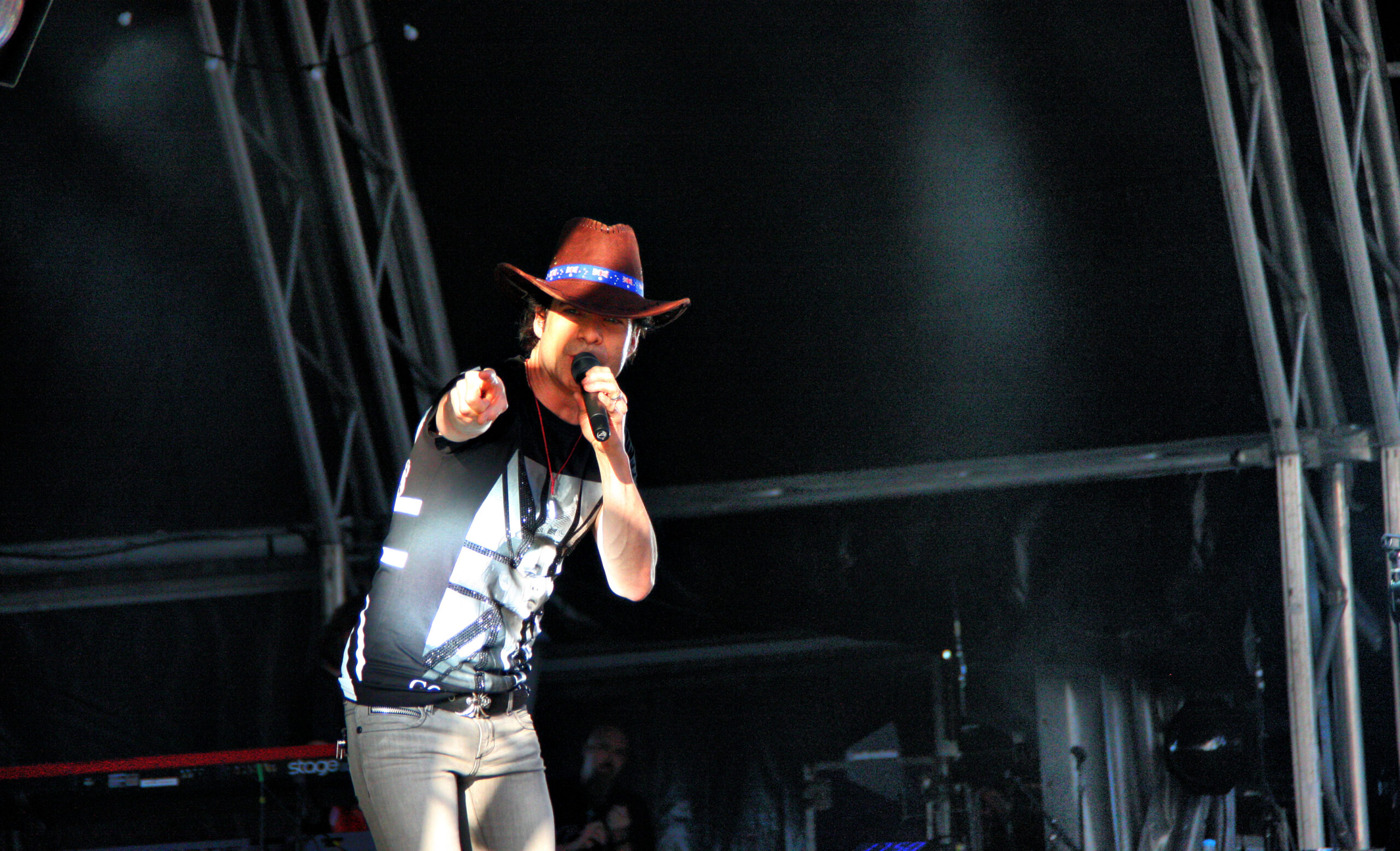
Image: INXS "photography Eva Rinaldi" (5406155771).jpg | Flickr | License: CC BY-SA 2.0 | Source: Wikimedia | https://commons.wikimedia.org/wiki/File:INXS_%22photography_Eva_Rinaldi%22_(5406155771).jpg