How Pharrell Williams Builds Minimal Hits: The Groove, Chords, and Gear Behind His Signature Sound
Pharrell Williams has a rare ability to make sparse arrangements feel huge. From clipped chord stabs to elastic drum programming and immaculate pocket, his minimalism is less about using less and more about placing every sound with intent.
Why Pharrell’s Minimalism Feels Bigger Than Full Arrangements
Pharrell Williams has spent decades proving that a record does not need layers to feel expensive. In fact, some of his most durable productions rely on the opposite instinct: remove anything that does not serve the groove, then make the remaining parts interact with almost surgical precision. That approach is central to the Neptunes era and still audible in Pharrell’s own records today. The result is a kind of controlled emptiness—space that feels intentional, rhythmic, and oddly luxurious.
What makes Pharrell’s minimal production so effective is that nothing is truly static. Even when a track seems stripped down, there is constant movement in the micro-details: drum placement, syncopated chord voicings, bass phrasing, percussion accents, and those tiny tonal shifts that keep a loop from feeling repetitive. Pharrell does not build density through layers of instrumentation; he builds momentum through interaction.
The Core Idea: Groove First, Harmony Second, Arrangement Last
One of the clearest lessons from Pharrell’s catalog is that groove usually leads the composition. Many producers start with a chord progression and then design drums around it. Pharrell often flips that relationship. A beat may begin with a drum pocket or a rhythmic accent idea, and only later receive chords that act more like punctuation than harmonic narration.
This is why his tracks can feel so instantly physical. The kick and snare are not just timekeepers—they are structural anchors. The hi-hats, percussion hits, and handclaps often function like conversational replies, creating a loop that feels alive without becoming busy. In Pharrell’s hands, groove is not an add-on. It is the entire architecture.
Chord Stabs, Not Endless Progressions
Pharrell’s harmonic language is famously economical. Instead of long progressions, he often favors short, memorable chord stabs or two-chord vamps that leave room for the rhythm section to speak. These chords are frequently voiced in a way that is slightly off-center: not overly lush, not overly theoretical, but catchy enough to stick after one pass.
That restraint is part of the signature. A lot of producers try to make minimal music feel sophisticated by stacking complex extensions everywhere. Pharrell tends to do the opposite. He chooses voicings that are simple but color-rich—minor 7ths, suspended shapes, bright major chords, or tightly voiced intervals that create tension through rhythm rather than harmonic movement. Because the chords are so concise, the ear focuses on placement and bounce.
A practical takeaway for producers: write chords that can function like rhythmic hits. Try a short two-bar loop with each chord landing slightly before or after the downbeat, then remove anything that does not improve the pocket. If the progression still feels compelling when played almost like percussion, you are closer to the Pharrell mindset.
The Drum Programming: Tight, Dry, and Unreasonably Human
Pharrell’s drum work is often deceptively simple on paper. The difference is in the feel. His drums tend to be dry, controlled, and sharply defined, with an emphasis on bounce over brute force. Snare hits may sit a touch behind the beat, kicks may be placed to push and pull against the bassline, and hi-hats often carry subtle swing or accented variations that prevent the loop from flattening out.
He also understands negative space better than most producers. A missing kick can be as important as a placed one. A sparse shaker pattern can create more energy than a wall of percussion if it leaves enough room for the vocal or lead line to breathe. Pharrell’s minimalism is not thin; it is disciplined.
If you are trying to emulate this approach in your own sessions, pay close attention to velocity variation, transient shape, and swing percentage. Use fewer drum sounds, but make each one count. The sound selection matters just as much as the pattern. A crisp snare with a short decay will read very differently from a roomy, washed-out snare, even if the MIDI is identical.
The Bassline as Glue, Not a Lead Character
In many Pharrell productions, bass is the bridge between harmony and groove. It rarely dominates the arrangement, but it is crucial to the record’s motion. Basslines often mirror the rhythmic contour of the drums more than the chord movement itself, creating a tight lock with the kick pattern or a syncopated answer to the vocal phrasing.
That means the bass is not always playing a full “line” in the traditional sense. Sometimes it is a repeating figure, a pedal tone, or a two-note pulse that supports the rhythm like a hidden hinge. The tone is usually focused, often with a clean low end and enough upper harmonic content to remain audible on smaller speakers. In minimal production, bass must do more than fill sub frequencies—it has to reinforce the groove’s identity.
Gear: Synths, Drum Machines, and the Importance of Sound Choice
Pharrell’s exact setups have varied over time, but the broader gear lesson is consistent: choose instruments that help you commit to the part. Classic analog and virtual-analog synths, tight drum machines, and keyboard sounds with immediate attack all fit the Pharrell ethos because they encourage decisive writing. The point is not to audition endless presets; it is to find a sound that already feels like a record.
His production lineage also reflects the Neptunes’ long-standing love of unusual timbres and offbeat textures. Instead of aiming for obvious “big” sounds, the team often selected tones that felt slightly unexpected—thin keys, nasal synth leads, punchy sampled stabs, filtered electric piano, or muted string-like textures. Those sounds work because they leave space around them. When a part is this minimal, the texture must carry personality.
For plugin users, the same principle applies. A great starting point is a synth that can produce clean plucks, short envelopes, and expressive filter movement. Think of instruments capable of a tight attack and a fast decay rather than massive pads. The fewer voices you have, the more obvious bad sound design becomes.
How Pharrell Uses Space Like an Instrument
One of the most overlooked aspects of Pharrell’s production style is how aggressively he uses silence. Space in his records is never dead air; it is part of the rhythmic conversation. A vocal ad-lib lands harder when there is a pocket around it. A chord hit feels more memorable when it is allowed to vanish. A drum fill becomes exciting because it interrupts a carefully managed grid of restraint.
This is a valuable lesson for modern producers working in DAWs that make it easy to overbuild. A session can quickly become cluttered with pads, layers, parallel synths, doubled percussion, and alternate hook ideas. Pharrell’s style suggests a different workflow: ask what happens if you delete half the arrangement. Then ask again. If the track gets better, not worse, you are probably on the right path.
Practical Production Takeaways for Modern Sessions
If you want to apply Pharrell’s minimal-hit strategy, start with these rules:
- Build around a drum pocket before adding harmonic complexity.
- Use short chord stabs or compact vamps instead of busy progressions.
- Choose sounds with immediate identity, not just wide frequency coverage.
- Let the bass support the rhythm as much as the harmony.
- Automate small changes in filter, velocity, or timing to keep loops from feeling static.
- Delete parts aggressively until the track feels exposed but still complete.
There is also a mindset component. Pharrell’s records often sound effortless because the arrangement decisions are highly edited. Minimalism only works when every piece feels chosen. If something is in the track because you were afraid of leaving space, it is probably weakening the record.
The Real Secret: Minimal Does Not Mean Simple
Pharrell Williams’ greatest production strength is not that he makes sparse beats. It is that he makes sparse beats feel authored. The ear hears simplicity, but the musician hears balance, timing, voicing, and restraint working in tandem. That is why his productions remain so influential across pop, hip-hop, and R&B: they demonstrate that a hit can be built from a few sounds if those sounds are arranged with taste and conviction.
For producers, the takeaway is clear. Minimalism is not the absence of ideas. It is the discipline to choose the right ones—and the confidence to leave the rest out.
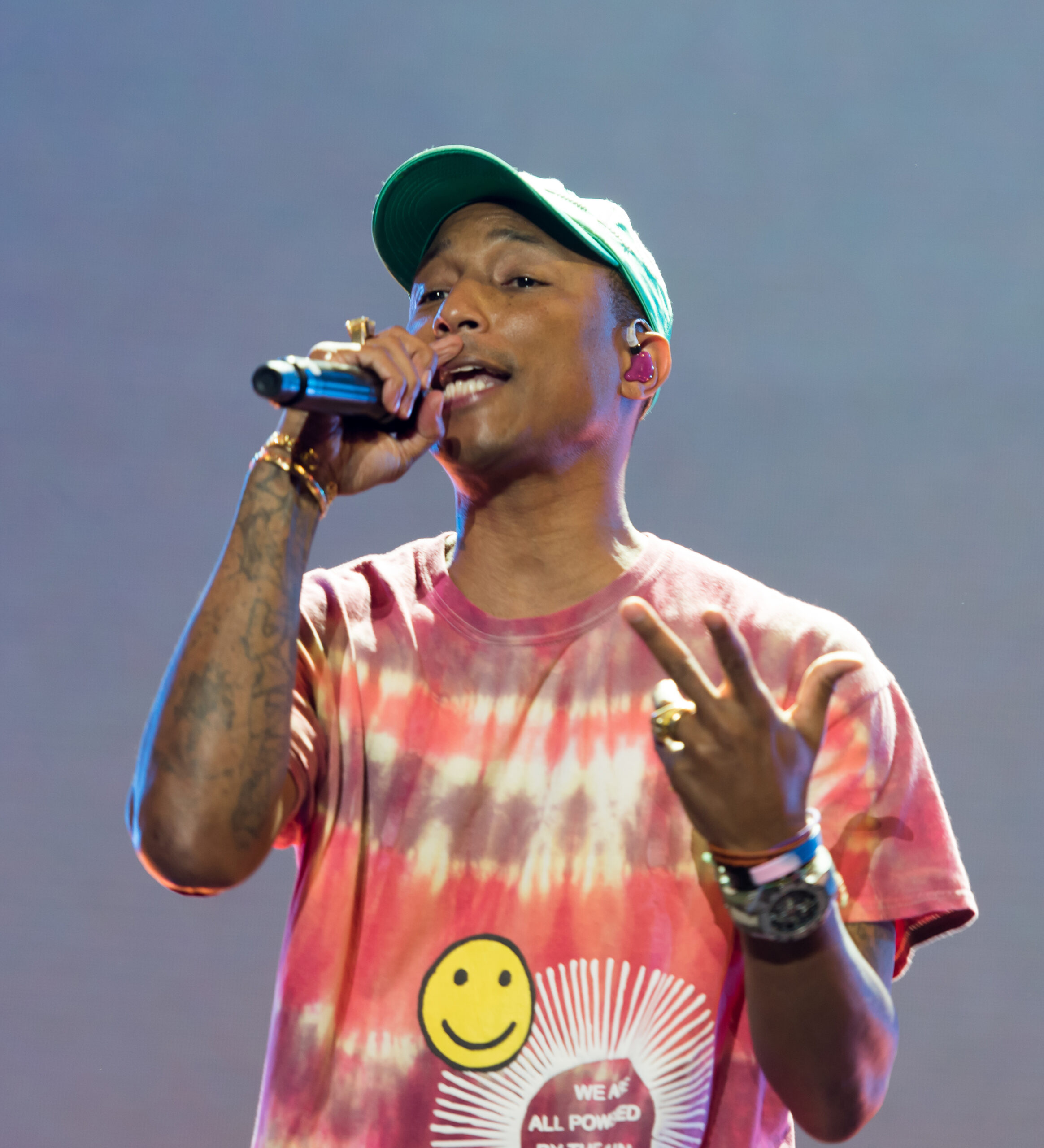
Image: File:Pharrell Williams – Global Citizen Festival Hamburg 11.jpg | Own work | License: CC BY-SA 4.0 | Source: Wikimedia | https://commons.wikimedia.org/wiki/File:Pharrell_Williams_-_Global_Citizen_Festival_Hamburg_11.jpg