Small Room, Big Truths: The Best Studio Monitors for Tight Spaces in 2026
Choosing monitors for a small studio is less about hype and more about translation, bass control, and the room’s brutal honesty. Here’s how the 2026 crop stacks up—and which models actually make mixing in tight spaces easier.
Why Small Rooms Expose Bad Monitor Choices Fast
A small room does not forgive much. Low frequencies pile up, reflections arrive early, and a monitor that sounds “impressive” in a showroom can become a liability once it is sitting three feet from your face between parallel walls. That is why the best studio monitors for small rooms are not necessarily the biggest, loudest, or most expensive. They are the ones that stay controlled in the low end, keep the midrange readable at short distances, and let you make decisions without fighting the room every ten minutes.
For 2026, the conversation has shifted away from pure size and toward accuracy under constraints. The strongest small-room options now combine well-managed bass extension, precise dispersion, DSP-based tuning where useful, and enough headroom to avoid strain without overloading the space. The goal is translation: mixes that hold together on headphones, cars, earbuds, and club systems after leaving the desk.
What Actually Matters in a Small Room Monitor

If you are working in a bedroom studio, a compact control room, or a spare office, the specs that matter most are not the flashiest ones. Start with the low end. A 5-inch monitor can be easier to place and may excite fewer room modes than an 8-inch model, but that does not automatically make it “better.” What matters is how the speaker integrates with your room and how honestly it presents the sub-bass and kick relationship.
Next, pay attention to off-axis behavior. In a small room, you are always hearing the speaker plus the room. A monitor with smoother dispersion will usually make the stereo image feel more stable and reduce the harshness of early reflections. Also consider rear-ported versus front-ported designs. Rear ports can work well, but they are typically more sensitive to wall distance. Front ports or sealed/controlled designs often make life easier when the speakers must sit close to a boundary.
Finally, think about listening distance. Nearfield monitors are built for this, but not all nearfields behave the same at 2 to 4 feet. Some like to be pushed back slightly; others are designed to stay composed on a meter bridge or desk. In a small room, that detail matters more than the badge on the grille.
The Best Studio Monitors for Small Rooms in 2026

1. Neumann KH 120 II
The KH 120 II is the benchmark pick for small-room seriousness. It is compact, deeply resolved in the midrange, and unusually controlled in the low end for its size. What makes it stand out is not just tonal balance, but the way it remains coherent when placed in less-than-ideal rooms. Neumann’s DSP and MA 1 calibration ecosystem give it a major advantage if you are trying to tame a reflective space without overcorrecting with foam and guesswork.
Why it wins: the image is stable, vocal placement is easy to judge, and bass is tight enough to avoid exaggerating room problems. If you write, edit, and mix in one space, this is one of the safest premium choices.
2. Genelec 8030C
The Genelec 8030C remains a reference for compact monitoring because it balances detail with fatigue-free listening. Genelec’s waveguide design helps the monitor stay consistent off-axis, which is a major plus when you are working in a small room with unavoidable reflections from the desk and side walls. It is not a “big bass” monitor, but it is a highly trustworthy one.
Why it wins: excellent imaging, strong low-mid clarity, and a sound that encourages longer sessions. If your room is especially small, the 8030C’s controlled presentation can be more useful than a speaker with deeper but less disciplined extension.
3. Adam Audio A7V
If you want a little more scale without jumping into room-troubling territory, the A7V is a compelling 2026 pick. Adam’s ribbon tweeter gives it a bright, revealing top end, which can be a strength or a trap depending on your taste and the acoustics around you. The key is that it exposes EQ mistakes quickly, especially in vocal air, cymbal sheen, and synth top layers.
Why it wins: strong detail retrieval and enough low-end authority for producers who work across electronic genres, pop, and dense arrangements. In a treated small room, it can be an excellent main monitor.
4. Focal Shape 65
The Shape 65 is one of the more musical choices in this category. It is known for a forward, highly readable midrange and a bottom end that feels present without becoming bloated. For small rooms, that’s a practical advantage. It lets you hear bass articulation and low-mid congestion without demanding subwoofer-level energy from the room.
Why it wins: excellent vocal and instrument definition, compact footprint, and a presentation that helps with arrangement decisions as much as mix decisions. If your work depends on mids—indie, acoustic, pop, post-production—it is a strong fit.
5. Kali Audio IN-5
The IN-5 has become a favorite because it delivers a three-way design at a relatively accessible price, and that matters in small rooms where midrange separation is often the real problem. The coaxial mid/tweeter arrangement helps imaging feel locked in, while the dedicated woofer keeps the low end more organized than many similarly priced two-way monitors.
Why it wins: impressive stereo focus and a very useful midrange picture for the money. If you are building a serious small studio on a realistic budget, this is one of the most intelligent buys available.
6. Adam Audio D3V
For ultra-compact setups, the D3V is a newer style of answer: small enough for a cramped desk, yet designed to be more honest than generic desktop speakers. It will not replace a full-size nearfield for bass-heavy mixing, but for production, writing, and editing in a very tight room, it is far more credible than most “computer speaker” alternatives.
Why it wins: tiny footprint, practical desktop usability, and enough clarity to make arrangement and balance decisions quickly. Best for creators who need a true monitor experience in a minimal space.
Best Picks by Room Size and Workflow

If your room is truly tiny—roughly bedroom scale with limited treatment—lean toward the Neumann KH 120 II or Genelec 8030C. Both prioritize control and translation over spectacle. If your room is small but treated enough to support a more revealing top end and slightly fuller low end, the Adam A7V and Focal Shape 65 are stronger creative monitors. If budget is a major factor, the Kali IN-5 offers unusually serious performance for the price.
For beatmakers and electronic producers, a little bass extension can help, but do not chase low end at the expense of definition. For vocal editors, podcasters, and engineers working on dialogue or hybrid music content, midrange truth is the priority, which favors the KH 120 II, Shape 65, and 8030C. If the desk is the room, the D3V is the outlier worth considering.
Placement and Calibration Matter as Much as the Speaker
Even the best small-room monitor will underperform if it is jammed against a wall, angled poorly, or set too wide for the listening position. In most compact rooms, start with the speakers forming an equilateral triangle with your head, tweeters at ear height, and the monitors pulled forward enough to reduce boundary buildup. A modest amount of absorption at first reflection points will usually do more for your mix decisions than upgrading one tier higher in monitor price.
Calibration tools can also make a meaningful difference. Systems like Neumann MA 1, Genelec GLM, and room correction from third-party interfaces or software can tighten the low end and flatten obvious room-induced anomalies. They are not magic, but in a small room they can be the difference between “guessing” and “working.”
The Short Version: Which Monitor Should You Buy?
If you want the most balanced premium pick for a small room, choose the Neumann KH 120 II. If you prioritize imaging and fatigue-free accuracy, the Genelec 8030C is still a classic for good reason. If you want a more forward, detailed sound with extra production energy, the Adam A7V is a strong contender. If you care most about mids and musical translation, the Focal Shape 65 deserves a close look. If budget matters and you still want genuinely serious monitoring, the Kali IN-5 is the sleeper pick. And if your space is so tight that traditional nearfields feel impractical, the Adam D3V fills a very specific but increasingly common niche.
In small rooms, the best studio monitor is the one that helps you stop second-guessing. That usually means control over hype, clarity over bass bragging rights, and a speaker-room relationship that stays predictable across long sessions. Buy for translation, place for accuracy, and treat the room like part of the system—because it is.
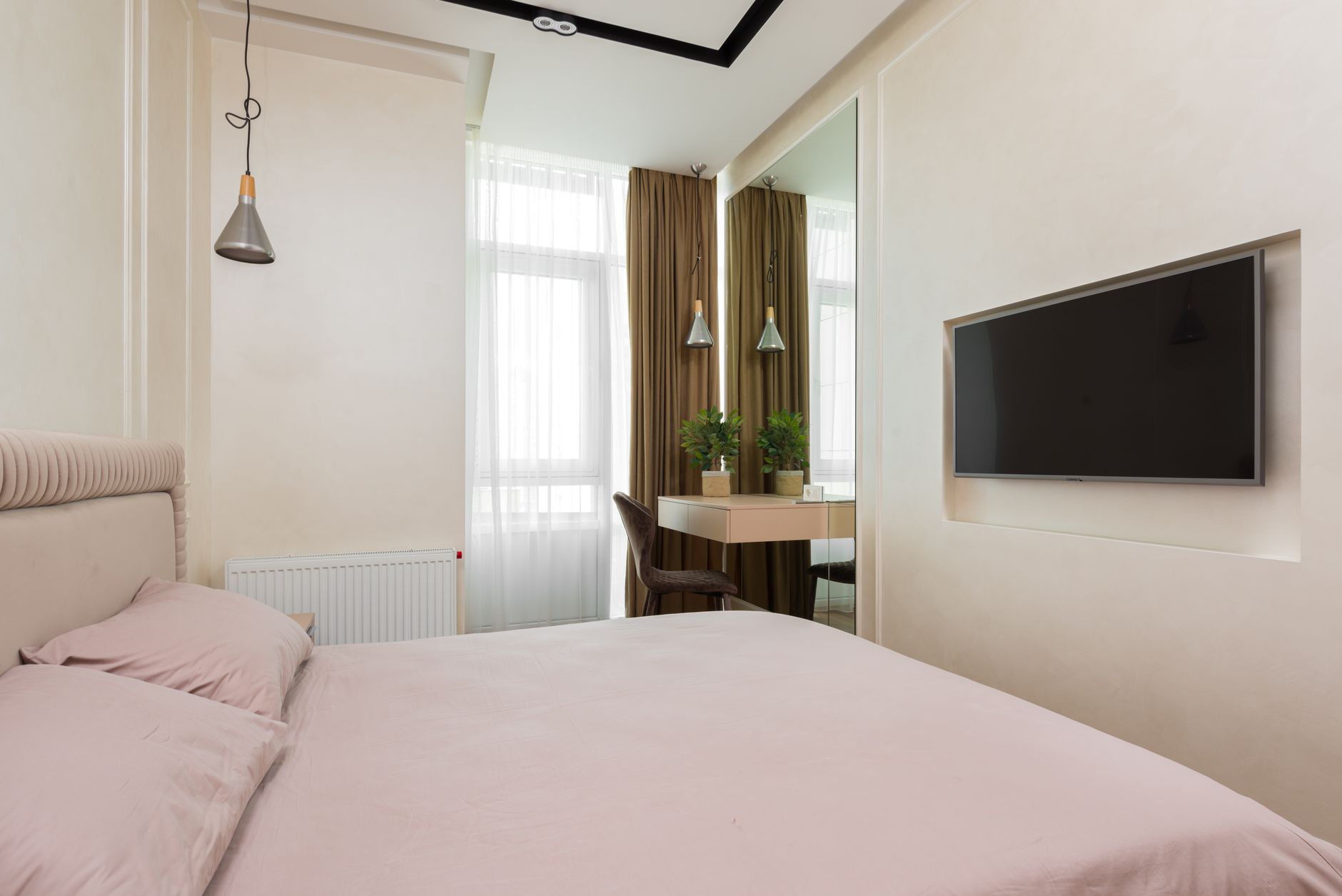
Image: Comfortable compact bedroom with big mirror near small window with curtains and TV placed on white wall against soft bed in modern apartment | Max Vakhtbovych | License: Pexels License | Source: Pexels | https://www.pexels.com/photo/light-bedroom-with-modern-furniture-ant-tv-on-wall-6636242/