How Deadmau5 Designs His Sounds: Inside the Synths, Serum Workflow, and Precision Behind His Production Style
Deadmau5’s sound design is less about flashy preset browsing and more about disciplined engineering, long-form arrangement thinking, and ruthless refinement. Here’s how his synth choices, Serum workflow, and mix-first mindset shape the records.

Why Deadmau5’s Sound Design Still Matters
Deadmau5 has never been a producer who treats sound design as decoration. In his catalog, the synth patch is not just a tone generator; it is usually the hook, the atmosphere, and often the structural glue holding the arrangement together. That’s why his work continues to be studied by producers across house, progressive, techno, and festival-oriented electronic music. He approaches sound in a way that feels both technical and musical: precise enough to satisfy engineers, but expressive enough to carry a track for seven or eight minutes without collapsing into repetition.
What makes his approach especially influential is that he does not lean on excessive processing to create identity. Instead, the identity is baked into the source material: waveform selection, modulation shape, filter movement, note voicing, and how a sound evolves over time. If you want to understand Deadmau5 sound design, you have to think less like a preset shopper and more like a systems designer.
The Core of the Deadmau5 Approach: Build the Patch Around the Arrangement
One of the biggest mistakes producers make is designing sounds in isolation and hoping they will work later in the track. Deadmau5 tends to work the opposite way. The sound is usually conceived in context, with the arrangement already influencing decisions about tone, width, transient profile, and how much harmonic space the patch should occupy. That’s one reason his productions feel so cohesive: the synth doesn’t fight the drums, the bass doesn’t step on the lead, and the transitions feel engineered rather than assembled.
This is especially clear in his more minimal, groove-driven records. Rather than layering five synths to create one massive moment, he often relies on a smaller number of parts that are carefully sculpted to leave room for movement. A single arpeggiated synth might be tuned to sit around the kick and sub, then automated to become brighter or more aggressive during a transition. The patch is designed to evolve, which means the arrangement stays alive without needing constant new musical material.
Deadmau5 and Serum: Why It Fits His Workflow
Serum is a natural fit for Deadmau5-style production because it offers exactly what his workflow rewards: visual control, clean wavetable synthesis, flexible modulation, and immediate feedback. The plugin’s strength is not just that it sounds modern. It’s that it makes complex movement easy to design and easy to remember when you return to a project months later.
Deadmau5’s Serum workflow, in practical terms, is likely to center on a few repeatable priorities. First, he will establish a strong harmonic source using a wavetable with enough character to survive processing. Second, he’ll shape the envelope so the sound has a specific function—plucky, sustained, pulsing, percussive, or swelling. Third, he’ll use modulation to create motion that feels intentional rather than random. In a Deadmau5-style patch, LFOs are rarely there just to “do something”; they define the rhythm of the sound itself.
Serum is especially useful for this because it allows producers to see what their modulation is doing. That matters when the sound is built around subtle filter movement, wavetable position changes, or macro-controlled brightness shifts. A Deadmau5 lead or chord patch often benefits from small but exact movements: a filter opening by just a few percent over eight bars, a tiny pitch drift on the attack, or a slow change in unison spread that widens the stereo image without making the patch obviously wider.
The Patch Formula: Simple Oscillators, Smart Modulation
Deadmau5 sound design often starts with a surprisingly restrained oscillator setup. Instead of throwing every oscillator mode at a patch, he tends to rely on clarity. A saw-based foundation, a slightly detuned unison layer, or a wavetable with a focused harmonic profile is usually enough. The important part is not complexity for its own sake, but how the sound reacts to modulation and mixing decisions.
For example, a classic progressive house lead might use a saw-like wavetable with moderate unison, a low-pass filter with envelope movement, and a subtle chorus or dimension effect for width. The real personality comes from automation: cutoff changes, envelope depth, reverb send adjustments, and careful EQ shaping. In other words, the patch is designed as an instrument that can be played over time, not just a static timbre.
Deadmau5 also tends to value contrast. His sounds often occupy a specific emotional register: cold but melodic, rigid but human, mechanical but deeply musical. That contrast usually comes from pairing synthetic precision with small imperfections—tiny pitch shifts, varying velocity, filter drift, or rhythmic delay tails that create a sense of breath.
Workflow Discipline: Why the Details Matter More Than the Preset
Deadmau5 has always been associated with meticulous project management, long-session refinement, and a producer’s obsession with details others might never notice. That mindset changes how sounds are built. If you know you’re going to revisit a project, automate it, resample it, and mix it across several sessions, you design patches that can survive that process.
This is where a lot of producers miss the point. Deadmau5 does not just sound “good” because he uses expensive tools or hidden tricks. He sounds good because his workflow is organized around repeatability and decisions. Every patch has a purpose. Every layer has a job. Every effect is there to solve a problem or sharpen a function. That kind of discipline is what turns a usable synth patch into a signature sound.
In Serum, this often means using macros to map the most important live controls: brightness, width, movement, and space. Macros keep a sound playable without opening the patch every time. For a producer working in the Deadmau5 lane, that means you can perform the buildup of a drop, automate an evolving chord bed, or morph a lead from dry and intimate into huge and cinematic with a few well-chosen controls.
Mix-First Sound Design: The Secret Most People Ignore
One of the clearest takeaways from Deadmau5’s production style is that sound design and mixing are not separate phases. They are part of the same problem. A patch that sounds huge in solo may be useless in a track. A sound that feels understated on its own may become perfect once it’s sitting against kick, bass, percussion, and reverb tails.
Deadmau5’s best sounds often work because they are mixed as they are built. High-pass filtering isn’t an afterthought; it’s part of the patch’s identity. Sidechain behavior isn’t just a bus trick; it’s part of the groove. Stereo width is not a generic “make it wider” move; it is carefully controlled so the center remains strong and the edges provide motion. This is why his arrangements feel spacious without sounding hollow.
For producers, the lesson is simple: if you design in Serum, finish the thought in the mixer. Set your sound in the context of the track, then trim, compress, saturate, and automate until the patch occupies a real role.
Practical Takeaways for Producers Trying to Emulate the Method
If you want to work more like Deadmau5, start by limiting your synth palette. Serum is enough if you know how to use it. Build one strong bass patch, one chord patch, one lead, and one atmospheric texture. Then spend more time automating those sounds than creating new ones. The goal is not variety for its own sake; it is depth.
Next, focus on movement. A static synth line rarely captures the Deadmau5 mindset. Use LFOs, envelopes, filter automation, and macro assignments to make the patch change over time. Even a small change in cutoff or wavetable position can create the feeling that the track is breathing.
Finally, think in terms of arrangement function. Ask what the patch is doing emotionally and sonically: Is it the hook? Is it tension? Is it transition material? Is it fill space? The more clearly you define that role, the more professional the result will sound.
Deadmau5 Sound Design Is a Philosophy, Not a Preset Pack
What separates Deadmau5 from producers who only chase tone is his understanding that sound design is structural. The synth is not just the sound; it is part of the composition, the arrangement, and the mix architecture. Serum makes that workflow more accessible because it allows producers to design with precision and revisit decisions quickly, but the real lesson is bigger than one plugin.
If you study Deadmau5 carefully, you’ll notice that his sounds are rarely overdesigned. They are controlled. Purposeful. Built to evolve. That’s why they age well, and why they remain such a useful reference point for producers who want their tracks to feel deliberate rather than random. If your goal is to make electronic music with clarity, tension, and identity, Deadmau5’s approach is still one of the best blueprints available.
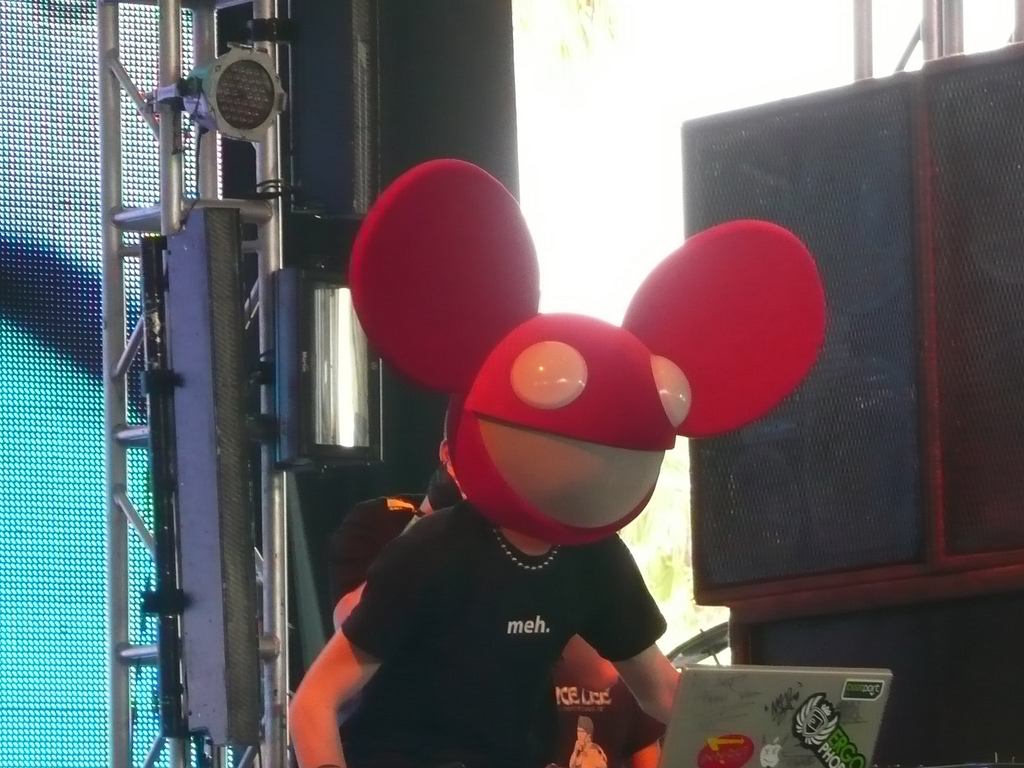
Image: Deadmau5 Belknap Park 2023.jpg | Own work | License: CC BY 4.0 | Source: Wikimedia | https://commons.wikimedia.org/wiki/File:Deadmau5_Belknap_Park_2023.jpg