Vinyl in the Studio: What It Still Does Better Than Digital for Producers
Vinyl is not a nostalgia object when you’re making records for release. For producers, it still offers specific strengths in tone, translation, and decision-making that digital workflows can overlook.
Why vinyl still matters in a digital-first studio
For all the advances in DAWs, mastering chains, and high-resolution distribution, vinyl has not gone away because it does something that files and playlists still can’t fully replicate: it imposes a physical, mechanical reality on music. That reality changes how records are mixed, mastered, heard, and valued. For producers, vinyl matters less as a fetish object and more as a format with hard constraints and distinctive rewards.
When people talk about vinyl “sound,” they often compress a lot of different factors into one phrase. The medium itself introduces subtle harmonic distortion, limited low-end stereo flexibility, groove-related compression, and playback variance from turntable to turntable. Some of that is coloration. Some of it is degradation. But for producers deciding whether vinyl is worth using, the important question is not whether it is “better” than digital. It is what vinyl forces your production to do differently, and when that difference helps the record.
Vinyl’s real strengths: tone, focus, and translation
The most useful reason to care about vinyl is not nostalgia. It is translation. A record that sounds balanced on vinyl often tends to translate well to speakers, because the format punishes lazy low-end, overcooked brightness, and overly wide stereo gimmicks. That makes vinyl a useful final checkpoint for music built in highly controlled environments like laptop studios or nearfield monitor setups.
There is also a tonal reason producers still chase vinyl pressings. Depending on the source chain and cut, vinyl can round off transients in a way that feels less brittle than hyper-limited digital masters. Hi-hats, sibilance, and bright synth layers can sit in a more forgiving place. On drums, especially kicks and snares, the format can produce a sense of density that reads as “musical” rather than clinical. That is not magic; it is the interaction between the cutting head, groove geometry, playback cartridge, and the physical limitations of the medium.
For genres like house, techno, hip-hop, dub, indie rock, and many forms of electronic music, those limitations are part of the aesthetic. They can add cohesion to a mix that is otherwise too separated or too pristine. A well-cut record can feel like the mix has been glued together with intention, not simply squashed by a limiter.
What vinyl forces producers to do differently
Vinyl is not forgiving in the same way as a DAW. If you are preparing music for a pressing, the format asks for practical decisions that improve the record long before the cutting lathe enters the conversation.
- Low end must be controlled. Excessive sub below roughly 40–50 Hz can create tracking issues and wasted groove space. Very wide stereo bass is especially risky, because out-of-phase low end can literally make cutting and playback unstable.
- High frequencies need discipline. Overly bright cymbals, harsh vocal esses, or aggressive synth tops can exaggerate inner-groove distortion and make the side harder to cut cleanly.
- Dynamic range becomes a sequencing issue. Vinyl sides have finite space. Louder masters take up more groove area, which means shorter sides or lower playback level. Long records often need more conservative level choices.
- Track order matters. The inner grooves on a record are less forgiving than the outer grooves. Sharper, denser, brighter tracks often fare better earlier on a side, while longer or more atmospheric material can sit later if arranged carefully.
These are not abstract mastering concerns. They affect arrangement, sound selection, and mix decisions. A producer who knows a record may be cut to vinyl will often build sessions differently: cleaner low-end layering, less unnecessary stereo spreading, and more disciplined top-end management. In that sense, vinyl can improve the work before the master ever exists.
Analog sound: what is real and what is myth
The phrase “analog sound” gets used loosely, but there are specific things happening. The vinyl chain usually includes analog stages at mastering, the lacquer cut, physical groove engraving, stampers, and then cartridge playback. Each stage can introduce harmonic distortion, noise, phase shifts, and transient softening. These changes can be pleasing, but they are not uniformly desirable.
For example, a synth-heavy track with aggressive top end may feel smoother on vinyl because the format slightly blunts the sharpest transients. A dense kick-and-sub arrangement may feel heavier, but only if it has been prepared correctly. On the other hand, a mix that relies on ultra-precise stereo imaging, very deep sub-bass, or extremely bright sparkle may lose some of its intended impact.
That is why experienced producers often treat vinyl as a format with character, not as a universal enhancement. It can flatter certain mixes and reveal weaknesses in others. The best vinyl cuts usually come from records that were designed with the medium in mind, not from files that were simply exported from a streaming master and handed off unchanged.
When vinyl is worth it for producers
Vinyl is not the right choice for every project. It is worth considering when the format aligns with the goals of the release, the audience, and the budget.
Vinyl makes sense if:
- you want a physical product that carries perceived value and artistic permanence
- your audience includes DJs, collectors, and physical-media buyers
- the music benefits from more disciplined low-end and top-end choices
- you are comfortable mastering specifically for the format
- the release is intended to live as an object, not just a file
Vinyl may not be worth it if:
- the budget is tight and the pressing quantity is small
- the music depends on extremely loud masters or deep sub-bass impact
- your main audience consumes music digitally only
- you are expecting vinyl to “fix” a mix that is already unbalanced
From a business standpoint, vinyl is expensive because the chain is expensive: mastering, lacquers, plating, test pressings, production runs, shipping, storage, and inventory risk all add up. But from a branding and fan-engagement standpoint, vinyl can also be one of the most effective formats available. It signals care, slows listening down, and gives buyers something that feels owned rather than streamed.
What to listen for when buying or cutting a record
If you are a producer evaluating whether vinyl is worth using, the most practical approach is to listen critically to records that succeed in the format. Don’t just ask whether they “sound warm.” Ask what the format is doing.
Pay attention to:
- Bass stability: does the low end stay solid without wandering or thinning out?
- Vocal and synth top-end: are esses and bright harmonics controlled without sounding dull?
- Stereo focus: do wide elements remain musical, or do they collapse awkwardly?
- Track spacing: does the record get softer or more crowded as the side progresses?
- Playback behavior: does the record play cleanly across different systems, or only on a very forgiving setup?
These checks are useful whether you are buying records, preparing a master, or comparing your digital mix against references. They train your ear for the real engineering tradeoffs behind vinyl’s reputation.
How producers can use vinyl without overcommitting
You do not need to press a full run to benefit from vinyl awareness. In fact, many producers get the most value from the format by using it as a reference framework.
Start by mixing with a vinyl-friendly mindset: keep the kick and bass mono or close to it, avoid unnecessary sub layering, and make sure the low end remains readable on smaller speakers. Check your top end for brittle peaks instead of only chasing loudness. If you are making club music, compare your mix against records that have actually been cut and played by DJs. If your track loses impact when the bass is simplified or the highs are smoothed, that tells you something about its arrangement and balance.
If you do decide to press, work with a mastering engineer who has real lacquer-cutting experience. A generic streaming master is not the right file to send. Ask for vinyl-specific sequencing, test pressing feedback, and side-length recommendations. That extra step is often the difference between a record that feels expensive and one that simply costs money.
The bottom line
Vinyl still matters because it is not interchangeable with digital production. It changes the sound, but more importantly, it changes the decisions behind the sound. For producers, that is the real value: vinyl encourages discipline, rewards thoughtful arrangement, and gives certain records a tactile final form that digital files cannot match.
If your goal is convenience, vinyl is inefficient. If your goal is a format that can sharpen your mixes, elevate a release, and give the music a lasting physical presence, it still earns its place in modern production.
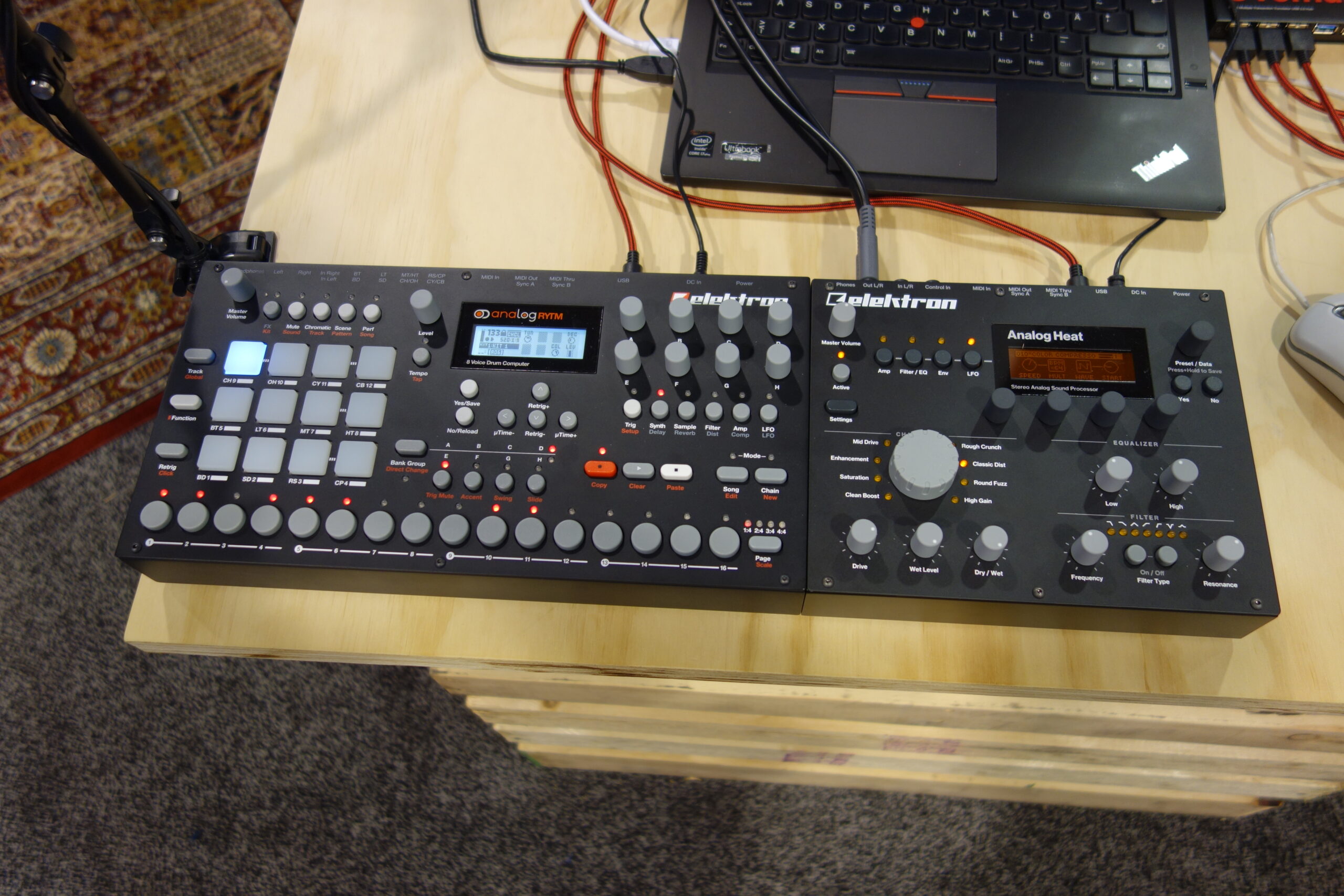
Image: Elektron Analog Rytm (drum machine, synth and sampler) & Analog Heat (stereo analog sound processor) – 2017 NAMM Show (2017-01 by Pete Brown @ Flickr 31629652064).jpg | DSC01627 | License: CC BY 2.0 | Source: Wikimedia | https://commons.wikimedia.org/wiki/File:Elektron_Analog_Rytm_(drum_machine,_synth_and_sampler)_%26_Analog_Heat_(stereo_analog_sound_processor)_-_2017_NAMM_Show_(2017-01_by_Pete_Brown_@_Flickr_31629652064).jpg