10 Indie Rock Albums That Still Define the Genre
From lo-fi scrappiness to widescreen emotional catharsis, these ten indie rock albums didn’t just shape the genre—they taught generations of musicians how to write, record, and feel differently. Here’s why they still matter, musically and culturally.

Why These Albums Still Matter
“Indie rock” has never been one sound. It’s a moving target: basement recordings, fuzzy guitars, emotional directness, elliptical lyrics, studio experiments, and, in many cases, a stubborn refusal to sound over-polished. The albums below aren’t just important because they sold records or won critical consensus. They matter because they changed how artists wrote songs, tracked drums, layered guitars, and thought about intimacy in rock music.
This is not a definitive canon so much as a practical listening map. If you produce music, engineer sessions, or just care about why certain records hit with such force, these ten albums offer a useful cross-section of indie rock’s evolution—from lo-fi home recording to expansive, studio-built emotional architecture.
1. Pavement — Slanted and Enchanted (1992)

Pavement’s debut is one of the great anti-perfection records, but calling it “sloppy” misses the point. Slanted and Enchanted is engineered around tension: wiry guitars, half-buried vocals, and songs that feel like they’re constantly threatening to fall apart before snapping into hooks. That instability became a template for indie rock’s cool detachment and sly melody.
Why it matters: It showed that rough edges could be a feature, not a flaw. The record’s lo-fi aesthetic made room for ambiguity—both sonically and lyrically—which became central to indie’s identity in the ’90s.
Production takeaway: Listen to how the guitars occupy different midrange pockets without trying to sound massive. There’s space in the mix, but it’s not clean in the modern sense. If you’re chasing this feel, think arrangement first: fewer parts, strong contrasts, and performances that leave room for personality.
2. The Strokes — Is This It (2001)

File:Nick valensi 2dollarbill.jpg
File:Albert Hammond, Jr. 2013.jpg
File:Nikolai Fraiture.jpg
File:Fabrizio Moretti (The Strokes).jpg | License: CC BY-SA 3.0 | Source: Wikimedia | https://commons.wikimedia.org/wiki/File:The_Strokes.jpg
If Pavement made indie rock feel permissibly unpolished, The Strokes made it feel stylish again. Is This It arrived with a compressed, immediate sound that pulled classic rock structure through a downtown New York filter: clipped guitar phrases, tightly controlled drums, and Julian Casablancas’ detached vocal delivery sitting just above the band like a cigarette haze.
Why it matters: This album helped reboot rock for the 2000s and gave indie a sharper, more marketable silhouette. It also reset expectations for guitar interplay: multiple parts, but never cluttered; energetic, but rarely messy.
Production takeaway: The record’s power comes from discipline. The guitars are arranged to interlock instead of compete, and the drums hit with an almost metronomic confidence. For producers, the lesson is simple: vibe is often a product of restraint.
3. Radiohead — OK Computer (1997)

Radiohead is often grouped as alternative rather than indie, but OK Computer belongs in any serious indie rock conversation because it expanded the genre’s emotional and sonic range. The album fuses paranoia, alienation, and technological dread with a production palette that feels both human and mechanized. It is lush without being smooth, experimental without becoming academic.
Why it matters: This record proved that rock could be intellectually ambitious and deeply affecting at the same time. It opened the door for sprawling arrangements, unconventional song forms, and studio textures that carried narrative weight.
Production takeaway: Note the contrast between organic performances and alien ambience. Reverbs, delays, and transitions are used like compositional tools, not just mix polish. The record is a masterclass in using texture to communicate theme.
4. Elliott Smith — Either/Or (1997)

Few albums capture fragile songwriting with as much precision as Either/Or. Elliott Smith’s gift was making intimate, almost whispered performances feel structurally complete. The arrangements are subtle—acoustic guitar, harmonies, occasional electric accents—but the emotional impact is enormous.
Why it matters: It defines a strain of indie built on confession, melodic sophistication, and understated arrangement. Many singer-songwriters borrowed Smith’s harmonic language and dynamic restraint without fully understanding how much discipline it required.
Production takeaway: Pay attention to the balance between directness and atmosphere. The record doesn’t rely on heavy processing to create intimacy; instead, it trusts mic placement, performance nuance, and tasteful doubles. For engineers, it’s a reminder that small sounds can carry huge emotional weight.
5. The Pixies — Doolittle (1989)
Transferred from en.wikipedia to Commons by Rcbutcher using CommonsHelper. Original uploader was ERcheck at en.wikipedia 23 May 2006 (original upload date) | License: Public domain | Source: Wikimedia | https://commons.wikimedia.org/wiki/File:Doolittle_LtCol_g41191.jpg
Doolittle is one of the clearest blueprints for loud-quiet dynamics in modern rock. The Pixies sharpened the tension between surfacing melody and abrupt aggression, creating songs that feel perpetually on the verge of explosion. Kim Deal’s bass lines, Joey Santiago’s jagged guitar work, and Black Francis’ surreal vocals all contribute to the album’s volatile architecture.
Why it matters: Without Doolittle, much of the ’90s alternative and indie guitar vocabulary sounds different. Its influence is visible in dynamic songwriting, angular riffs, and the strategic use of restraint before impact.
Production takeaway: The key lesson here is contrast. Don’t flatten a song’s emotional curve in the mix. Leave the verse lean if the chorus needs to feel like a release. Indie’s most effective records often understand impact as a matter of subtraction before addition.
6. Built to Spill — Keep It Like a Secret (1999)
Built to Spill turned guitar exploration into a form of indie storytelling. Keep It Like a Secret is spacious, melodic, and deceptively intricate, with long-form guitar phrases that never feel indulgent because they’re anchored by strong songwriting. Doug Martsch’s playing is expressive without showing off, and the arrangements bloom in slow, satisfying layers.
Why it matters: This album helped define the “big-hearted guitar band” version of indie rock: emotionally generous, musically adventurous, and unafraid of extended instrumental sections.
Production takeaway: The record is a lesson in maintaining clarity when guitars are doing a lot of the storytelling. Keep your low end disciplined, let melodic parts occupy different registers, and resist the urge to over-stack every section.
7. Arcade Fire — Funeral (2004)
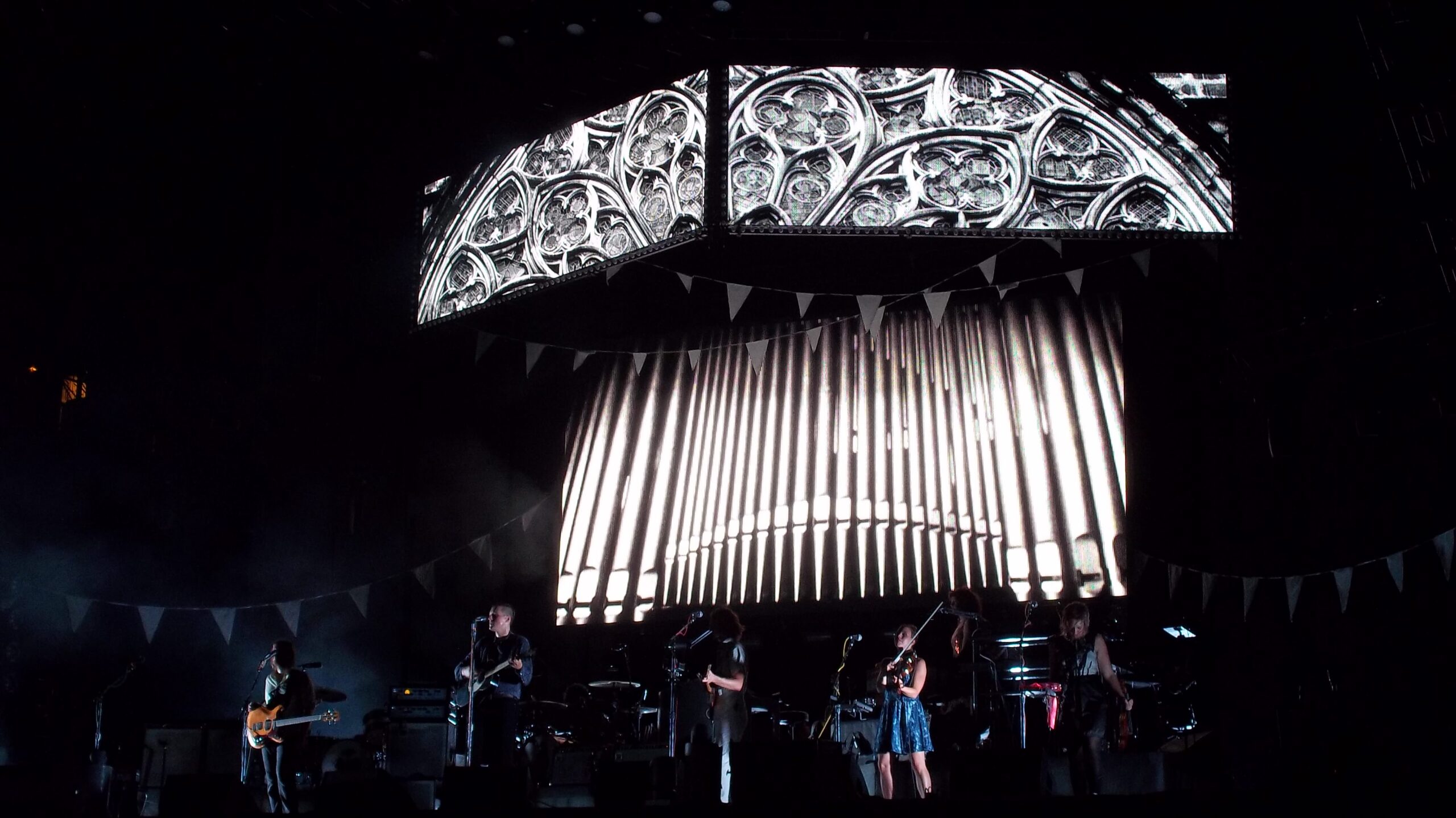
Funeral made indie rock feel communal. In place of detached cool, Arcade Fire delivered urgency, group vocals, orchestral swell, and arrangements that sounded like they were built for emotional collapse and collective release. It’s grand, but not in a corporate-rock way; the record still feels handmade, even when it’s reaching for the rafters.
Why it matters: This album helped indie rock become festival-scale without losing critical credibility. It also normalized theatrical dynamics, multi-instrument layering, and songs that move like scene changes.
Production takeaway: Notice how the arrangements are dense but not muddy. That kind of clarity depends on disciplined frequency management and a strong sense of arrangement hierarchy. Every layer has a role; nothing is present just to sound “full.”
8. Neutral Milk Hotel — In the Aeroplane Over the Sea (1998)
This is the album that turned indie rock into a mythology factory. In the Aeroplane Over the Sea is raw, surreal, and emotionally disorienting, with distorted acoustic textures, unconventional phrasing, and a spiritual intensity that has only intensified over time. It feels handmade in the deepest possible sense.
Why it matters: The record collapsed the distance between bedroom songwriting and historical epic. Its influence can be heard in lo-fi aesthetics, eccentric lyricism, and the idea that imperfection can enhance emotional legitimacy.
Production takeaway: The roughness is part of the narrative. The tonal saturation, tape-like grit, and unvarnished vocal character all contribute to the album’s haunted quality. Sometimes fidelity is less important than psychological texture.
9. Sonic Youth — Daydream Nation (1988)
Sonic Youth brought art-rock abstraction into indie’s bloodstream. Daydream Nation is expansive, noisy, and deeply intentional, with alternate tunings and guitar feedback used as compositional material rather than decoration. It’s one of the records that makes the guitar sound like a city: dense, unruly, and alive with friction.
Why it matters: This album widened the vocabulary of guitar-based music and made dissonance feel structurally useful. It influenced everything from noise rock to shoegaze-adjacent indie to experimental post-punk revivalism.
Production takeaway: The mix doesn’t smooth out the edges of the band’s tuning experiments; it frames them. If you want to understand how to keep chaos legible, this is essential listening.
10. Modest Mouse — The Lonesome Crowded West (1997)
Modest Mouse’s second album is prickly, expansive, and emotionally ragged in a way that still feels fresh. The Lonesome Crowded West captures the weirdness of American sprawl with spiky guitars, off-kilter rhythms, and Isaac Brock’s voice riding the line between rant and revelation.
Why it matters: It crystallized a more restless, fragmented form of indie rock—one that could be funny, bleak, and expansive all at once. Its influence runs through the more jagged end of the 2000s indie canon.
Production takeaway: The arrangements thrive on asymmetry. Instead of smoothing the performances into a polished grid, the album lets them lurch and pivot. That instability gives the songs their nervous energy.
What These Albums Teach Producers and Musicians
Across these ten records, a few themes keep appearing. First: arrangement is destiny. Indie rock’s most durable albums usually sound distinctive because they know what to leave out. Second: texture matters as much as melody. Whether it’s lo-fi grit, compressed urgency, or orchestral sprawl, the sonics are part of the songwriting. Third: emotional clarity often comes from technical discipline, not endless polish.
If you’re producing in this lane, spend as much time on part selection and dynamic contrast as you do on plugin chains. The best indie records don’t just document a performance—they shape a worldview through tone, space, and imperfection.
The Short Version
If you want the fastest path into indie rock’s core DNA, start here: Slanted and Enchanted, Doolittle, Either/Or, Funeral, and In the Aeroplane Over the Sea. Then move outward into the more expansive, experimental, and genre-bending corners of the list. Together, these albums explain not only what indie rock sounded like, but why it kept changing.
That’s the real value of a great indie album list: not nostalgia, but perspective.
Image: Orleans – album-guide. 1843 (127855099).jpg | This file comes from Polona Digital Library and is available under the URL: https://polona.pl/item/orleans-album-guide,MTI2NTQ0MTc3/16/ | License: Public domain | Source: Wikimedia | https://commons.wikimedia.org/wiki/File:Orleans_-_album-guide._1843_(127855099).jpg